%201.svg)




What Is Production Control?
Production control is all about meeting your production targets on schedule and maintaining the highest possible output quality.
This is achieved by implementing tools and processes that help with:
- Monitoring
- Coordinating
- Regulating manufacturing activities
Production control is the bridge between what has been planned and how that plan is actually executed on the shop floor. And as it’s an important part of production scheduling and manufacturing processes, it extends across many different functions of a business, including:
- Demand planning
- Capacity planning
- Production scheduling
- Inventory management
- Costing
- Shop floor control and monitoring
- Quality control
But, in a nutshell, production control is ultimately about making sure that labor, materials, machine capacity, and cost are allocated properly and used efficiently, so production runs without overburdening any of the above.
What is the Difference Between Production Planning and Production Control?
%20(1).jpg)
Maybe you’re a bit confused by the earlier section, since production control covers a wide range of things, many of which creep into the territory of production planning.
Production planning vs. production control? Which is it?
The truth is, the terms production planning and production control are often used interchangeably, since the two rely on each other:
- Planning — Decides how and what is going to be made, and when
- Control — Turns that plan into action, adjusting plans and production based on real-time information
Planning also involves demand forecasting and capacity assessments to understand how production is going to take place, but production planning needs a lot more information for a plan to be as plausible as possible, drawing from several data points before reaching the execution stage, looking into things such as:
- Material requirements planning
- Routing
- Scheduling
And how control differs is turning all this into work orders and instructions for operators on the shop floor to follow, and for managers to have a system to track manufacturing order progress, flag any problems or bottlenecks before they escalate, and perform corrective measures to keep operations functioning.
So, now that those differences (or lack thereof) are cleared up, let’s delve back into production control and focus on the stages that define the process.
The 5 Stages of the Production Control Process
Production control happens across five stages:
- Planning
- Routing
- Scheduling
- Dispatching
- Follow-up
And this happens in stages as an item moves from conception to a finished product ready for delivery.
Stage 1: Planning
Production control begins at the planning stage, in which the “How to” is written up, detailing how much time, resources, equipment, and materials will be required to complete the production run for either a single product, a batch of goods, or a continuous production flow.
Stage 2: Routing and Loading
Once the plan is completed, you will need to figure out the routing, which means how the raw materials and subassemblies will move through the shop floor during different production stages.
Then, from the routing map, you’ll need to determine loading, which involves assigning and balancing the workload across the production stages you’ve highlighted along the route. The purpose of doing this is to ensure that no point in the route becomes clogged with WIP items, creates bottlenecks, or leaves other stations idle while they wait for one stage of production to wrap up.
For example, imagine an assembly line that builds chairs from pre-cut materials. Painting the chairs black is going to take longer than slotting them together. The goals of routing and loading are to ensure that both of these stages are operating without being overwhelmed.
To perform your routing, you’ll need to take into account cycle and setup time estimates alongside expected yields from the production run, so the schedule for the entire production run is based on realistic operational timelines and the amount you’ll produce once production wraps up.
Stage 3: Scheduling
With your plan and route, you can start assigning times to each production stage and estimate how long it will take to finish production.
Another thing to take into consideration is the size of the batch, because it’s a lot quicker to make one chair than it is to make seven, and your timings will have to change depending on how much you expect to produce during the run (while ensuring that it’s possible to hit delivery deadlines).
Stage 4: Dispatching
With everything planned and the schedule looking good, you can start dispatching, which basically means releasing everything that is needed to begin production, including:
- Work orders
- Materials
- Instructions
And, if no unforeseen hiccups crop up, you should theoretically have a smooth production run, which leads us to the next stage.
Stage 5: Follow-Up and Periodic Audit
As optimistic as we were in the previous stage, sometimes things don't go according to plan, and it’s important to investigate this and close the production loop with a follow-up to compare actual performance against the expectations of the plan.
Whatever information you find, whether variances in production or missed deadlines, can be used for future planning cycles to give better estimations or understand where your gaps are.
It’s always a good idea to pair these follow-ups with a periodic audit and formal inspection to analyze your production processes as a whole, rather than only reviewing what could have gone better run by run, since this will help identify recurring issues in production that might slip by if just concentrating on day-to-day operations.
Then, through iteration and perpetual improvement, follow-ups and audits will help you close the gap between what you expected production to look like and how it actually turned out, until you reach a point where your plans are spot on.
6 Common Production Control Problems Manufacturers Face
As you can tell, production control relies on a lot of information and trial and error to get it pitch-perfect — meaning there are a lot of issues that can pop up and ruin your production control efforts.
Without proper tools or systems, one issue or gap in just one aspect of your production ripples into the rest of your operations, particularly if there are gaps or incorrect assumptions around:
- Visibility
- Forecasting
- Scheduling
- Resourcing
- Quality
Here are the six most common problems manufacturers face when trying to improve their production control, as well as the solutions you can follow to resolve them.
1. Limited Shop-Floor Visibility
Most manufacturers lack real-time insight into what is actually happening on the shop floor at any given moment.
Without that visibility, planning systems are forced to work with stale or incomplete data, leading to bottlenecks and unreliable downstream decisions. The underlying cause is often an IT/OT convergence gap, meaning enterprise systems like ERP and manufacturing execution systems (MES) are disconnected from operational systems on the floor, such as machine sensors. Plans get built around ideal conditions, but execution rarely matches them:
- Machines go down
- Setups run long
- Materials arrive late
- Workers fall back on informal workarounds
This fragmentation is often made worse by historically evolved processes that are difficult to scale or adapt, along with outdated or inconsistent parts lists and work plans, both of which erode coordination and contribute directly to delivery problems.
Closing this gap requires integrating ERP, MES, and shop-floor data into a single, unified operational picture rather than treating them as separate systems that must be manually reconciled.
Real-time data capture through Industrial Internet of Things sensors, tighter MES integration, and role-based dashboards that surface insights without manual reporting all move planners toward a continuously updated view they can act on as conditions shift.
2. Inaccurate Demand Forecasts
Traditional demand forecasting models were built on the assumption that demand eventually reverts to historical norms, but that assumption no longer holds in an environment shaped by geopolitical disruption, trade policy shifts, climate events, currency swings, and increasing customer-driven customization, all interacting at once.
For manufacturers with long lead times, a forecasting error made early in the planning stage can cascade through multi-month production cycles, creating inventory imbalances, misallocated capacity, and strain on suppliers further down the chain.
The more effective approach is moving from single-point forecasts to scenario-based models that let teams weigh multiple possible demand outcomes rather than betting on one. Feeding trade policy data, shipping data, and market indicators directly into planning workflows, shortening planning cycles from monthly to weekly, and connecting sales pipeline data directly to production planning all help teams react before small forecasting misses turn into larger ones.
3. Mismanaged Scheduling and Job Sequencing
Even accurate forecasts and strong visibility can be undone by poor scheduling execution.
A common failure pattern is releasing jobs prematurely to avoid the risk of starting late, which floods work-in-process with too many active orders at once, creating congestion, extending wait times, and blurring priorities across the floor. A related failure is due-date myopia, where jobs are sequenced strictly by delivery date rather than by operational complexity. A job due later may actually carry more risk if it involves outsourced steps, additional operations, or subassemblies that need to start earlier. Ignoring that reality means high-risk work gets started too late, even though the schedule looks on time on paper. Poor capacity planning compounds these effects, driving excess stock and further bottlenecks that feed back into delivery problems.
Fixing this requires constraint-aware scheduling that accounts for machine capacity, labor availability, material readiness, and setup requirements together, rather than defaulting to a static, due-date-driven plan.
Controlling work-in-process by releasing jobs at the right time rather than the earliest possible time keeps flow stable, and dynamic sequencing that adjusts to real-time conditions allows the schedule to keep pace as circumstances change.
4. Resource and Labor Shortages
For manufacturers relying on complex, long-lead components from a limited pool of qualified suppliers, a single missing part can halt production of an entire high-value system, with a delay in one component cascading into downstream congestion and missed delivery commitments.
Labor constraints compound the pressure — even when materials arrive on schedule, a shortage of skilled technicians can still stall execution.
Addressing this means building variability assumptions directly into the production plan rather than treating disruptions as anomalies. Diversifying supplier bases for critical components, holding strategic buffers for long-lead items, strengthening supplier collaboration through shared forecasts, and improving visibility into sub-tier supplier dependencies and labor availability all help surface potential disruptions before they halt production.
5. Quality Control Treated as a Final Inspection Step
Quality control is frequently positioned as a validation step at the very end of production rather than a planning constraint built in from the start.
By the time a defect is caught under that model, the materials, labor, and capacity behind it have already been consumed, and the resulting output is often unusable. Because rework probability and yield variability are typically left out of the schedule, production plans end up more optimistic than conditions warrant, and the impact of rising defect rates under schedule pressure often stays invisible until orders are already at risk.
For high-value, customer-critical products, a single quality failure can trigger rework that consumes planned capacity across multiple jobs, and a defect that reaches the customer carries costs well beyond rework, including service-level penalties and long-term relationship damage.
Treating quality as an upstream planning factor rather than an end-stage check means building historical defect rates and yield variability directly into scheduling decisions, capturing quality signals earlier through in-line monitoring and statistical process control, and connecting quality systems to planning systems so real-time performance data can inform scheduling adjustments as they're needed.
6. Adjacent Operational Challenges
A few additional pressures sit just outside production control itself, but shape the environment it operates in, closely enough to warrant noting.
Shifting consumer expectations around packaging, including hygiene, shelf life, ease of use, and environmental impact, along with rising brand loyalty tied to values alignment, are pushing manufacturers to rethink labeling and sustainability practices alongside the product itself. Workforce retention is a related pressure, with roughly 22% of the current manufacturing workforce expected to retire within the next decade, making training programs and structured onboarding increasingly important even as automation absorbs some of that labor gap. Finally, keeping pace with new production technology requires manufacturers to baseline their current workflow, typically through a line analysis, before evaluating labor, equipment, and process maturity to identify where investment will actually move the needle.
And there we have it! Everything you need to know about production control and why it’s important to master within your own manufacturing processes.
However, as we mentioned, the only true way to implement the best production control practices is to automate your workflows, such as using a manufacturing and inventory management system like Digit.
Getting Production Under Control with Digit
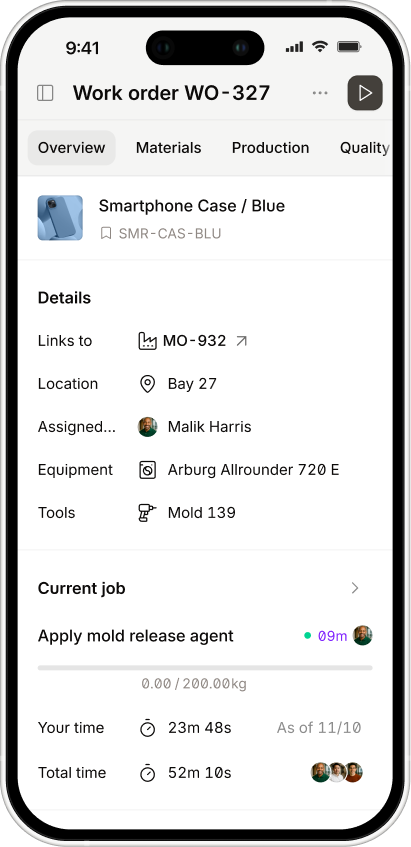
Visual input: Screenshot of Digit or someone using Digit.
Digit is a cloud-based manufacturing and inventory management platform built for small and mid-sized manufacturers looking to centralize:
- Shop-floor operations
- Inventory
- Order management
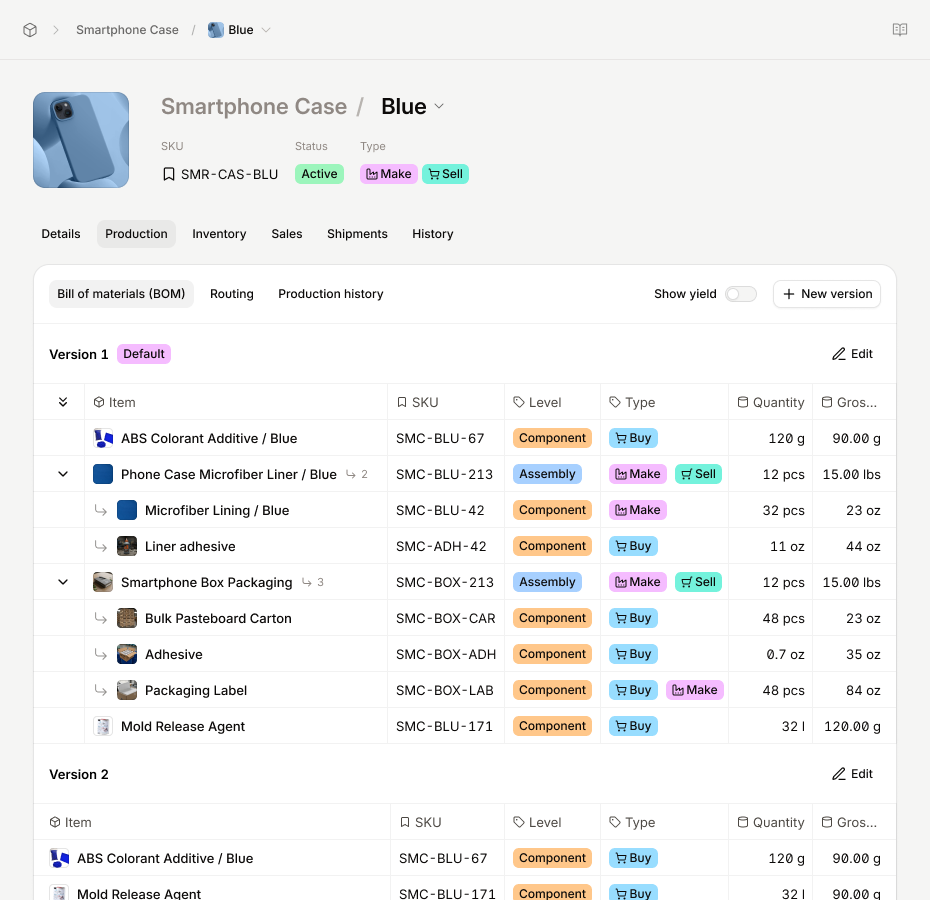
At the center of production control in Digit is the Manufacturing Order, the main production job that defines what item to produce, the target quantity, the required materials pulled from the bill of materials, and the routing steps the job will follow. Each Manufacturing Order breaks down into individual Work Orders, which represent the discrete steps inside it, such as cutting, assembling, or painting, giving operators a clear, step-by-step view of what's required to move a job from start to finish.
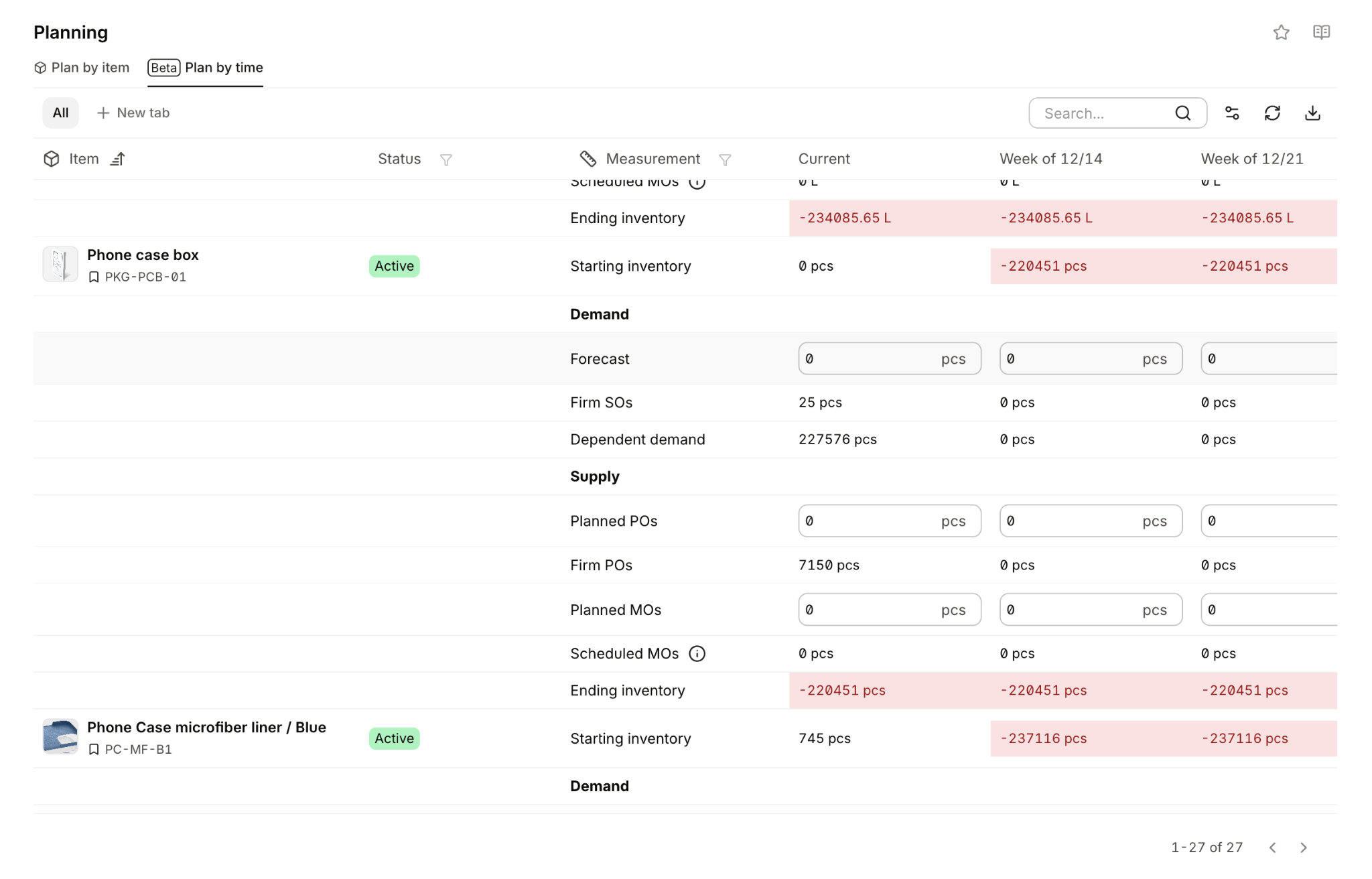
Before production begins, the Planning view gives visibility into the demand and supply side by side, surfacing forecasted demand, firm sales orders, and dependent demand alongside planned and firm purchase orders and planned or scheduled manufacturing orders. This lets managers see where supply will fall short of demand before it becomes a problem, and schedule production runs and target dates accordingly.
Once a job is running, Digit's MRP functionality tracks raw materials, work-in-progress, and finished stock automatically to prevent shortages mid-run, while bill-of-materials management supports single- and multi-level structures with full version control.
Yield Loss Display tracks efficiency in real time by comparing expected output against actual quantity produced and surfacing the gap as a percentage, and Actual Costing calculates the real cost per unit as the job progresses, factoring in material costs, tracked labor time, and optional overhead, with a final per-unit cost locked in once the Manufacturing Order is completed. Inventory traceability rounds this out through barcode scanning, custom label creation, and lot or serial number tracking, providing the audit trail needed for recalls, quality claims, or supplier accountability.
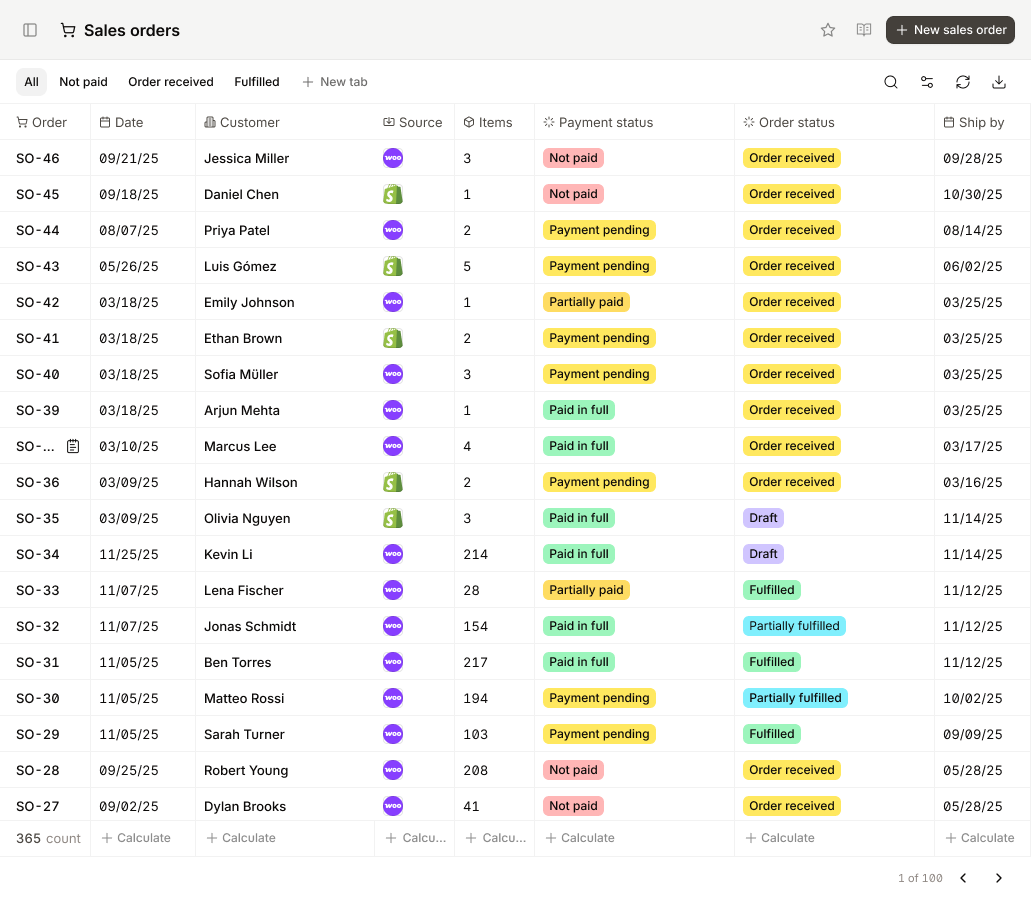
Digit also connects production to the commercial side of the business, so accepted sales quotes convert directly into manufacturing orders, e-commerce orders from platforms like Shopify and WooCommerce import automatically, and accounting tools like QuickBooks Online sync directly, reducing the manual data entry that typically separates sales, production, and finance into disconnected systems.
Are you looking for a tool to take your production control to the next level? Then why not book a call with an expert from Digit? They would be happy to guide you through how Digit can fit into your specific workflows.



.jpg)