

What Is MRP (Material Requirements Planning)?

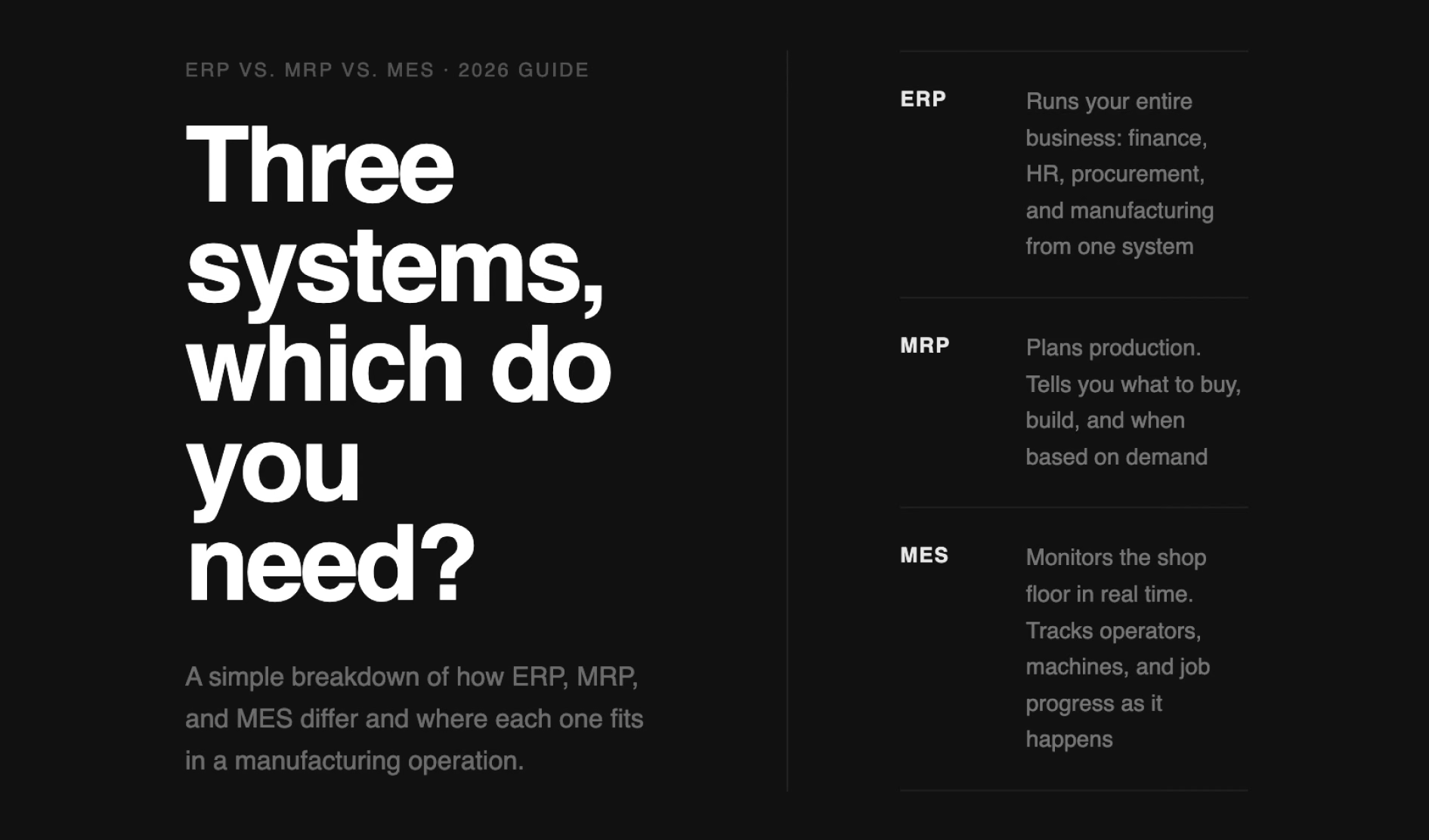
Material Requirements Planning, or MRP for short, is software that gives manufacturers the tools to:
- Manage inventory
- Plan production
- Handle procurement
The main purpose of an MRP is for manufacturers to understand which materials they need, how much they need, and when those materials will arrive, to ensure a smooth production run and keep inventory levels high enough to fulfill production without raising carrying costs by storing excess inventory.
To achieve this, an MRP pulls data from different parts of the business, and uses that information to help you generate purchasing and production recommendations that align inventory with forecasted demand, looking at info such as:
- Current inventory levels
- Open purchase orders
- Expected sales
- Assembly schedules
What Is ERP (Enterprise Resource Planning)?

Next, we have Enterprise Resource Planning, or ERP for short, a system that integrates all your business functions and operations, and centralizes them in one place, so you can manage your entire organization, including:
- Finance
- HR
- Procurement
- Supply chain
- Manufacturing
- Project management
Running your entire business in one solution, it means you and your different teams can all work from the same information, helping to avoid duplication and inconsistencies that tend to crop up when teams are working in disconnected systems.
So, by using an ERP manufacturing system, you’re not only able to manage your day-to-day operations, but it can support you with high-level financial planning, helping you improve:
- Budgeting
- Forecasting
- Reporting on financial results
What Is MES (Manufacturing Execution System)?
.jpeg)
Finally, we have the Manufacturing Execution System, or MES for short, a solution specifically designed to monitor your manufacturing operations on the shop floor.
So, where MRP focuses on managing raw materials, and ERP focuses on the high-level organizational stuff, MES is concerned with how tasks are getting done on the shop floor. MES software comes in all different shapes and sizes, so how they achieve their goals will differ, but it is common to see MES solutions capturing data in real time by monitoring:
- Machines
- Sensors
- Operators
Having access to this information helps you and your managers identify bottlenecks and minimize downtime by spotting potential issues early and addressing them before they become bigger problems later.
Now you know what the tools are when it comes to ERP vs. MRP vs. MES, the next challenge is to understand exactly how they are different from each other and which is the best for you.
ERP vs. MRP: Key Differences

Starting with the classic: ERP vs. MRP — given that they differ by a single letter, it’s easy to understand why people get confused.
But ultimately, you can understand the difference between ERP vs. MRP as follows:
- MRP — A tool for manufacturing, helping you manage your inventory and production
- ERP — A tool for managing an entire organization, centralizing essential business functions
MRP means making sure you can produce items. ERP means ensuring your business runs optimally. An MRP might only be used by your production planners and teams who handle inventory, while an ERP could be used by finance teams to create profit reports or HR teams managing payroll or headcount. Due to the specialized nature of an MRP, it tends to function standalone, while ERPs are designed to be integrated with other departments so everyone can easily share data back and forth.
As you can imagine, the biggest gap between the two is complexity and cost.
An MRP system is typically easier to implement and less expensive to maintain, so if you’re a smaller manufacturer with limited resources, then it can be a great choice to get your operations up and running. But an ERP requires a lot of investment, both time and money, and depending on the size of your operations, can take months to years to fully implement, with lots of other hidden costs like hiring onboarding specialists.
MRP vs. MES: Key Differences

Now you might be raising an eyebrow because we just explained that MRP is a tool for manufacturing, but we’re talking about MES, which has "manufacturing" in its name! So, what’s the difference?
You can look at it like this:
- MRP — Plans production days, weeks, or months in advance to ensure material levels match production demands before manufacturing begins
- MES — Tracks production in real time, to ensure production runs are on schedule and running smoothly based on the production plan
We like to use chess analogies.
There’s your strategy, what you will do to win the game, that you plan with MRP. Then there’s your tactics, the things you do during the game, planned with MES. Both your plan and your tactics can change based on the realities of a situation, and MRP and MES solutions help ensure you can still meet your goals.
But, in case you’re not a fan of chess, MRPs are concerned with:
- Inventory levels
- Bills of Materials
- Supplier lead times
- Purchase planning
While MES, on the other hand, is concerned with:
- What's happening on the production floor right now
- Which operator is running which machine
- How much WIP is moving through each stage
- What the scrap rate is
- Whether quality checks are being met
Pro tip: Don’t get too caught up in finding two separate solutions to manage these functions, as many tools nowadays offer features to manage both MRP and MES tasks and responsibilities. Check out our article on The 6 Best MRP Software for Manufacturers.
ERP vs. MES: Key Differences

When it comes to ERP vs. MES, you can probably already guess the major difference from this article:
- ERP — Big picture overview, how your business is doing
- MES — Focusing on a corner of your business, specifically what’s happening on the shop floor
You would use your ERP for long-term business planning, like:
- Resource allocation
- Financial management
- Organizational growth
Your MES will help you and your team understand what needs to happen on the production floor today, and whether it's happening correctly.
How you implement MES and ERP will be vastly different, with MES implementation more similar to an MRP implementation (given its smaller scope). When adopting an MES solution, you can customize it to fit your manufacturing processes and equipment, whereas an ERP (as already mentioned) is a long, pricey implementation given that it’s designed to run your entire business.
You might look into adopting MES if you’re looking for a tool that can be used by anyone who needs access to production data, like:
- Operators
- Process engineers
- Plant managers
Which System Does Your Manufacturing Business Need?

Choosing the right system, or even deciding if you need a combination of systems, comes down to four factors:
- The size and maturity of your operation
- The complexity of your manufacturing process
- Your industry's compliance requirements
- Where your most pressing bottlenecks actually sit
Smaller manufacturers typically begin with a cloud-based ERP that includes built-in MRP functionality, which is enough to manage information across departments without significant overhead, like:
- Orders
- Inventory
- Costs
As operations grow, adding MES becomes the logical next step to improve shop-floor visibility and coordination.
Budget constraints don't have to prevent this progression as some manufacturers deploy MES first because it tends to be faster and less expensive to implement than ERP, then invest in broader ERP capability once the business has scaled.
Simpler assembly operations may not require MES immediately, but as product mix grows, custom work increases, or tolerances tighten, the need for consistent execution and full traceability becomes harder to meet without it. Regulatory environment is a related consideration in industries like food and beverages, chemicals, cosmetics, and electronics, as they often require MES not as an optional enhancement but as a compliance necessity, since ERP alone rarely meets the documentation and process enforcement requirements those sectors demand.
When it comes to pain points, the diagnosis is usually straightforward.
If the primary challenge is knowing what to order and when, MRP is the place to start. If the challenges are downtime, quality escapes, or a lack of real-time production status, MES is the more immediate priority.
How ERP vs. MRP vs. MES Plays Out in Practice
A large automotive manufacturer might use ERP to handle high-level scheduling and procurement, MRP to plan component ordering, and MES to sequence tasks on each assembly line, guide operators through torque checks, and capture test results, as well as use a full stack working together to meet customer delivery targets and maintain certified traceability.
A 50-person custom fabrication job shop might start with a cloud ERP to manage quotes, sales orders, and purchasing, then add a lightweight MES module as they grow to capture job progress and operator input, gaining efficiency incrementally without disrupting current operations.
A pharmaceutical manufacturer uses ERP to manage long-lead raw materials and financials, while MES enforces:
- Tracking batch and lot data
- Logging environmental conditions
- Auto-generating records for regulatory compliance
Most competitive manufacturers don't choose one system over another as they often integrate all three so that data flows continuously from the shop floor to the executive level. And in most cases nowadays, when it comes to ERP vs. MRP vs. MES, some platforms cover all three.
Where Digit Fits In
.jpeg)
One thing that might have become clear to you as you have read through this article — most manufacturers who want to operate competitively need all three layers:
- Planning
- Execution
- Business-wide management
The traditional path to getting there means assembling multiple enterprise systems, navigating complex integrations, and absorbing the cost and implementation time that comes with each.
For many small and mid-sized manufacturers, that path is either out of reach or simply not worth the disruption.
This is where Digit comes in.
Digit is a manufacturing and distribution software that brings MRP, manufacturing ERP, and shop floor control together in a single connected platform, purpose-built for manufacturers rather than adapted from generic enterprise software. Planning, production, inventory, purchasing, and shop floor execution all run from the same system and draw from the same data.
Using Digit, operators on the floor can record work, scan materials, and log job progress from any device without installing specialist software, while managers get live visibility into:
- Production status
- Inventory levels
- Job costs
Procurement teams can act on accurate, real-time demand signals rather than working from stale reports. For manufacturers who have outgrown spreadsheets but don't need the complexity or cost of a system like NetSuite or SAP, Digit offers a middle ground, helping you cover the full stack without requiring an enterprise-scale implementation.
Want to see for yourself? You can chat with Digit's free AI demo, allowing you to test the solution and ask questions tailored to your organization, and see how, when it comes to ERP vs. MRP vs. MES, Digit is an all-in-one solution.