


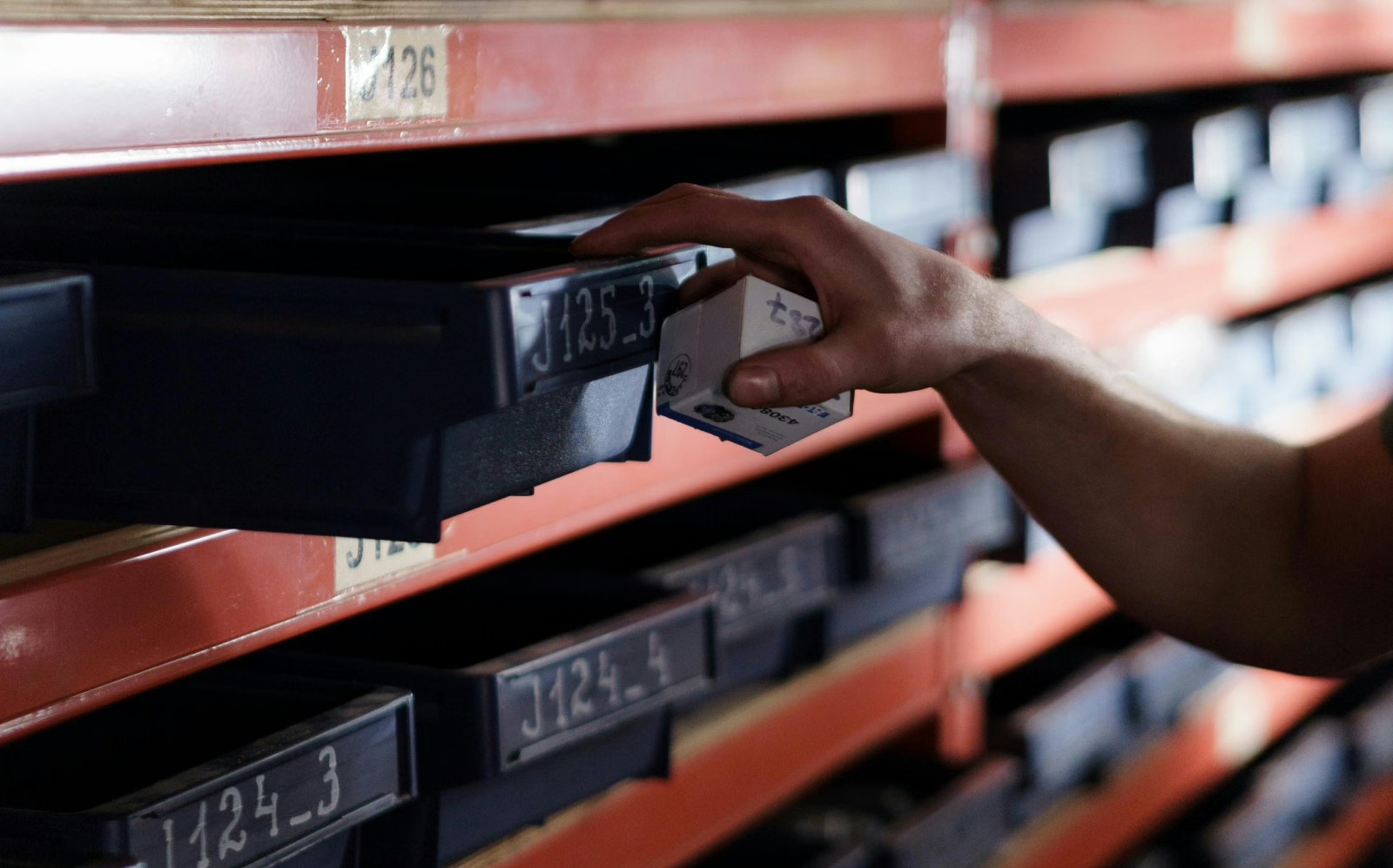
What is Cycle Counting in Inventory?

Inventory cycle counting is an auditing process in which a selected group of products in inventory is counted at regular intervals, rather than halting operations for a full inventory count.
The checks can be performed at any interval, and they are usually carried out:
- Daily
- Weekly
- Monthly
However regularly you decide to perform your inventory cycle counts, the ultimate goal of this is to ensure all your inventory is audited at least once to make sure that inventory counts are correct, while still having resources available to continue other operations.
With cycle counting inventory management, you can define which items to count in a way that works best to decrease the likelihood of a disruption. So, it’s not a matter of just picking an item and counting all the identical stock — you can divide your inventory cycle counts by:
- A specific category
- Storage area
- Group of SKUs
However often and in whatever way you decide to group your inventory, the purpose is to compare the physical inventory count against the data displayed in your system and investigate any discrepancies and address them before they become a larger problem.
Cycle counting is a standard practice in inventory management, and if it’s something you’re not doing within your business, it is something you should implement. Cycle counting helps maintain inventory accuracy across:
- Warehouses
- Retail operations
- Manufacturing facilities
- Distribution centers
And to help you implement inventory cycle counting, here are 5 methods to consider.
5 Types of Cycle Counting Methods
Before you get started, you should understand that there isn’t a single cycle counting method that works for every operation.
Deciding which is the best for your business depends on what you’re trying to achieve, and even the types of operations your business performs and the products that you sell. For example, you may want to concentrate mainly on your most valuable products or implement it to identify inefficiencies in your workflows. You may even end up finding that a combination of methods works best for you.
Either way, here are 5 types of cycle counting methods you can use in your business.
1. ABC Cycle Counting
ABC cycle counting is probably the most widely used method among businesses that store physical goods.
ABC counting categorizes all your inventory into three tiers, based on:
- Value
- Turnover rate
- Sales contribution
Based on this tiering system, the frequency with which you perform cycle counts is based on the following:
- A-items — these are your highest-value or fastest-moving stock. Your A-items will be counted more frequently, on a daily, weekly, or bi-weekly cadence, because any discrepancies with your A-items will carry the highest costs.
- B-items — these are not as valuable as your A-items, require a little less attention, and can be counted monthly.
- C-items — these are your lowest-value stock. They move slowly, making up the bulk of SKU count but a small fraction of sales value, counted least often — typically quarterly.
2. Random Sample Counting
If you’re pressed for time or can’t spare the resources for counts at fixed schedules, another option is a sampling approach.
In a random sample, items are selected at random. A benefit of this is that when counts are scheduled, your staff may make corrections ahead of the count to avoid past mistakes being discovered. But when the process is random, the snapshot of inventory accuracy is more honest.
Although random sample counting shouldn’t be the primary method of counting and should be used as a supplementary process, its purpose is to catch systemic errors that scheduled counts may miss.
3. Control Group Counting
The control group tests the counting process itself.
Using this method helps you stress-test your counting processes by selecting a small, fixed group of items to be counted repeatedly over a short period, maybe even several times in a single day. If the results are the same after each count, congratulations, your process is working just fine. However, if the results differ each time, that means something is going wrong with the count, which could indicate things like:
- Unclear procedures
- Labeling issues
- Inconsistent technique among staff
This method is particularly useful when implementing cycle counting for the first time, when count results seem unreliable, or when training new staff on counting procedures.
4. Location-Based Counting
As mentioned earlier in the article, another method is to not count items by SKU or value, but instead perform your counts based on locations, such as aisles, bays, shelves, or bins, and count everything within that zone.
This approach is useful when a particular area of the warehouse is suspected of harboring organizational problems:
- Misplaced stock
- Bin confusion
- Labeling errors that wouldn't be caught by item-focused methods
5. Usage-Based Counting
Usage-based counting prioritizes items by transaction frequency rather than unit value.
High-touch items are counted more often because each movement is a potential point of error, regardless of what the item is worth. This method complements ABC counting, which focuses on value, by identifying accuracy problems in fast-moving, lower-value stock.
And there you have it! 5 inventory cycle counting methods you can use within your business to ensure that your actual inventory levels are correctly displayed in your system.
However, this process is made even simpler if you’re using an inventory management system that can automate your inventory counts.
Cycle Counting with Digit
.jpeg)
If you’re looking to break free of spreadsheets or need to replace your current inventory management software because it’s giving you more problems than solutions, we recommend checking out Digit.
Digit is a modern manufacturing ERP platform that gives you and your teams everything you need to ensure that when you do perform your inventory counts, the physical count matches what's displayed in Digit.
In Digit, you can perform your inventory counts via a customizable view on the Labels tab.
Here, a dedicated count view can be set up to display exactly the information you and your staff need to perform inventory counts effortlessly, such as:
- Bin location
- Item name
- Label number
- Quantity
- Unit of measure
- Package type
Grouping first by bin and then by item means counters can move through the warehouse in a logical, physical sequence, checking each location systematically rather than jumping between areas.
If you and your teams would still prefer to work from a spreadsheet during inventory counts, the count view can be exported to a spreadsheet and uploaded back into Digit — it will then automatically adjust inventory levels.
Want to see for yourself? Book a demo and we'll walk through the count view setup on a bin structure that looks like yours — so you can see exactly how one of the methods from this article would run in Digit.

%20(2).jpg)