


What Is Location Control and Bin Management?
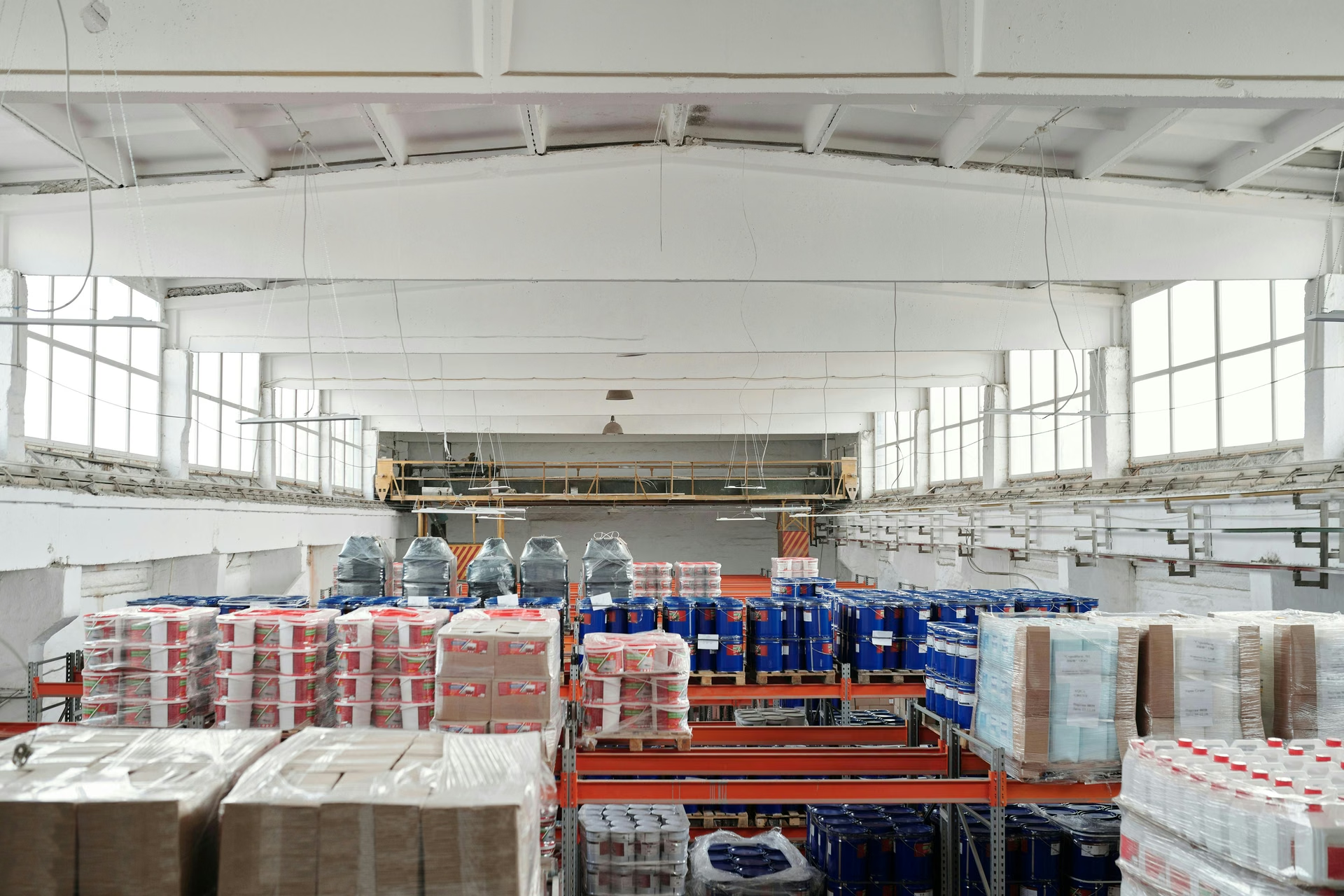
Location control is the process of organizing all the inventory in your warehouse via bin management. This means placing all your items in predefined storage locations, rather than finding any free spot on your shelves or in your warehouse — these locations are called bins.
Location control and bin management will see that every bin has a unique identifier, helping you and your operators track exactly where all your products, components, and supplies are stored at any given time.
A bin location system is going to help your team reduce the time they spend searching for items, minimize picking errors, and improve inventory location management visibility across your warehouse since you’ll know where items are and how much stock you currently have on hand. That’s location control and bin management in a nutshell — it is also known as warehouse slotting (we will dive into this a little more soon).
A warehouse location system is complex, comprising a comprehensive framework for assigning, organizing, and managing all storage areas across a facility. It will not only tell you all about designated bins, but it will also include information on helping you find items, such as:
- Aisles
- Shelving units
- Racks
- Bin locations
It will detail the routes, raw materials, and finished goods that move along them, so you can see whether your current setup produces the least amount of waste* in your warehouse.
Most businesses achieve this by using a tool such as a Warehouse Management System (WMS), as manual spreadsheets and paper-based tracking aren’t efficient enough for maintaining this information, and lack real-time updates and automation.
*What is waste? In this context, waste isn’t just a physical resource. It stems from lean processes, meaning removing any action that adds no value to the customer. Waste in this instance would be keeping a product that is regularly purchased far from the shipping station, resulting in time spent walking from the bin back to the shipping station.
What Is Warehouse Slotting Optimization?
Warehouse slotting optimization is the process of planning and placing inventory into the most appropriate storage locations within a warehouse or distribution center —essentially, it is the term used to describe location control and bin management.
There are two ways you can go about warehouse slotting optimization (which will be covered throughout the article), and that is either with:
- Automation
- Manual
Warehouse slotting software — It will use historical and real-time data to help you determine the best places in your warehouse to store inventory.
Manual warehouse slotting — A disconnected source of data, either on paper, in spreadsheets, or even in the head of someone in the warehouse, where slotting decisions are based on assumptions as opposed to demand.
But to not complicate this topic any further, we’ll leave the introduction to warehouse slotting there and move to the factors that come together to form what will eventually be your warehouse slotting strategies.
Key Components of Bin Management Systems
If you’re looking to improve how you manage your inventory and warehouse operations, you will need to consider these components to get started.
Location Hierarchies and Bin Structures
To optimize your bin management, you will need to clearly define your location hierarchy.
What this means is analyzing how your warehouse is organized. Most businesses do this by assigning unique, trackable storage locations:
- Zones
- Aisles
- Racks
- Shelves
- Bins
Once you have a standardized process for storing your inventory, for example, by demand or item type, you will have an address system for every SKU documented for any worker to access and understand where everything is and goes.
Quick tip: Many businesses use the ABC method for storing items. ABC inventory places the items in highest demand closest to the shipping area.
Receiving and Putaway Logic
Bin management begins at receiving.
Inbound items are verified against purchase orders upon arrival at your warehouse and then assigned to appropriate bin locations during putaway. This will be easy once you have your location hierarchies and bin structures organized. The only thing that you will need to consider for this is the labels you generate.
At this stage, the labels you create need to ensure that:
- Inventory is identifiable
- Inventory is traceable as it moves through your warehouse
Inventory Location Tracking and Movement Control
You know your routes and products, so it’s time to store items and move inventory throughout the warehouse.
Bin management systems track every movement between locations and maintain an accurate record of:
- Transfers
- Picks
- Replenishments
- Adjustments
This, in turn, provides audit trails and, if you’re using software, cycle counting tools to support ongoing accuracy without requiring full physical counts.
Order Fulfillment Support
Bin-level location data powers efficient picking and packing workflows.
Now that processes are defined, and the tools are in place for tracking, your pick lists will better direct staff to exact bin locations, and using barcode scanning, they can confirm items and quantities during fulfillment.
Traceability and Compliance Capabilities
We’ve touched a little on traceability already, since if you have properly implemented warehouse slotting, you will be able to support this anyway.
However, some businesses, such as food and beverage companies, operate in highly regulated industries, and traceability may be legally required. First, manual processes will be out of the question for you, and you will need to implement software for lot, batch, and serial number tracking, helping you maintain a history of product movements to help you with:
- Recalls
- Compliance reporting
- Quality inspections and investigations
Reporting and System Integration
And, as long as you’re using the correct software, many come with reporting tools that give you insights into:
- Inventory distribution
- Bottlenecks
- Stock aging
Integrations with e-commerce platforms, shipping systems, and accounting software ensure bin-level inventory data remains consistent across the entire operation.
And there you have it, the core components to implementing warehouse slotting. If you focus on improving these areas, what can you expect to see?
7 Benefits of Location Control for Distributors
Now that you have this information, you can start optimizing and streamlining your warehouse slotting — this is where the fruits of your labor will show.
1. Improved Inventory Confidence and Accuracy
There will be no ambiguity about where anything is stored in your business.
Since every SKU will be assigned to a predefined location, you and your staff can use your system to find things, even at a glance, ultimately reducing misplaced inventory and reconciliation issues. A properly configured system will provide the latest information on on-hand stock quantities, empowering you to make more reliable purchasing decisions and avoid surprises during your audits.
2. Faster, More Consistent Order Fulfillment
Once you have your bin locations clearly defined, you and your warehouse teams can spend less time searching for items and more time fulfilling orders.
Anyone assigned pick tasks knows exactly where the correct locations are, which will reduce delays and give you a standardized and clearer understanding of your order processing times, making it easier to detect any bottlenecks in your warehouse.
3. Lower Operational and Labor Costs
It’s not only time you’ll save, but also money, as location control reduces wasted labor from:
- Searching for products
- Correcting errors
- Handling returns from mis-picks
Another thing that you’ll be able to do is handle higher order volumes without increasing your headcount, as (at least theoretically) inefficiencies have been removed, leading to more time for your workers to handle more orders.
4. Better Use of Warehouse Space
Having all your storage spaces defined and mapped out means an inventory that is organized intentionally.
To make that sound less vague, what we mean is that you will have your products grouped and stored based on:
- Demand
- Size
- Location to shipping and workstations
If done correctly, this could even free up space and allow you to increase the number of SKUs you carry in your warehouse.
5. Easier Cycle Counting and Ongoing Accuracy
No one likes to do it, but inventory counts have to happen, and by organizing your bins, you at the very least make that task a little less painful.
Since your inventory is organized by location, cycle counting makes it easier to verify small portions of inventory regularly, maintaining accuracy without shutting down operations for full physical counts.
6. Scalability as the Business Grows
As already covered, warehouse slotting reduces waste (travel times, space utilization, etc.), meaning that you have more space to easily:
- Add new products
- Customers
- Facilities
Now you’ll have a framework you can apply whenever something is introduced, providing scalability and control. New SKUs can be assigned locations quickly, and additional warehouse staff can be onboarded without relying on tribal knowledge or informal processes.
7. Stronger Customer Satisfaction and Reliability
Finally, as you experience the positive ripple effects of this level of optimization, it is going to extend to your brand's reputation, too.
Accurate inventory, faster fulfillment, and fewer errors mean providing better service to customers and clients, since you will have:
- Fewer stockouts
- Fewer shipping mistakes
- Predictable delivery timelines
Warehouse Slotting Strategies for Distribution Operations

Now, you have the theoretical knowledge to start implementing effective warehouse slotting to overhaul your distribution operation and improve how fast and how many orders you can fulfill.
Warehouse Slotting Best Practice #1: Slot Inventory by SKU Velocity
A foundational warehouse slotting strategy is to organize inventory by how quickly it moves through your warehouse.
There are different ways of doing this, like mentioned earlier with ABC inventory management, but ultimately you’re looking into Fast- and medium-moving SKUs and placing them in the most accessible locations (most typically closer to packing stations or primary pick paths), while your slower moving stock is stored farther away or in less accessible areas so it doesn’t block your routes.
It’s a fairly straightforward strategy to follow. However, the challenge lies in maintaining accurate velocity data, which is essential to ensure products remain slotted appropriately as demand shifts. Meaning what you may define as a top-selling product today might reach the end of its lifecycle/popularity tomorrow, and you’re going to have to reorganize your warehouse again.
Warehouse Slotting Best Practice #2: Slot by Zone, Equipment, and Access Method
Either way, you know that your SKUs are assigned based on velocity, the next step is to determine their precise placement within storage.
This means taking into consideration:
- Product dimensions
- Weight
- Handling requirements
For example, you might sell a variety of products that may have different requirements, such as pallet racks, while others are better suited to shelving, flow racks, or bin storage. This information is going to affect where you store your inventory, because if you need a forklift to move some items, then it doesn’t make sense for items that need to be moved with a forklift to be at either end of your warehouse.
Another thing to take into consideration is the days during which your items remain in storage. For example, for medium-moving SKUs, it’s a daily common practice for operations to aim to maintain a roughly 20-day supply in primary pick locations, as keeping less than this often increases replenishment labor, while storing significantly more may consume valuable space that could be better allocated to other products.
Warehouse Slotting Best Practice #3: Slotting as an Ongoing Process
One of the most challenging aspects of warehouse slotting optimization is that it is never truly complete.
Like we already said, product demand changes, maybe due to popularity or seasonal demand. Or perhaps you introduce new SKUs, which change the demand for your inventory. To remain effective, warehouse slotting must be treated as a continuous cycle of:
- Data collection
- Analysis
- Adjustment
- Review
If you make it a recurring task to revisit slotting regularly, you will be able to constantly maintain efficient, high-performing fulfillment workflows in your warehouse, regardless of the challenges that come your way.
The trick is to get ahead of these changes rather than be reactive to them.
Implementing Bin Location Tracking in 5 Steps

If you liked what you’re reading, and you realize it’s time to seriously overhaul the setup within your warehouses, here’s a mini-guide showing you how you can implement a warehouse slotting strategy into your workflows.
1. Plan Your Inventory and Storage Structure
Begin by assessing your product catalog and storage capacity.
Group your products based on all the factors we have covered in the article, doing this by analyzing SKU:
- Categories
- Sizes
- Handling requirements
- Demand
From there, review your warehouse space, divide it into clear zones, and determine how many bins are needed in each area.
2. Organize Bin Locations and Labeling Standards
Know where your bins will be located and establish a consistent labeling process.
For example, using large, easy-to-read labels that align with your internal naming conventions, as well as implementing codes, usually alphanumeric, that identify:
- Zones
- Aisles
- Racks
- Bins
Better yet, implement software that allows you to use barcodes or RFID tags to further improve the accuracy of inventory counts. Using scanning technology will help your employees confirm item locations instantly, reducing manual errors and speeding up both picking and putaway processes.
3. Train Staff for Consistent Execution
A strategy is only good if it is able to be executed, and execution will depend on your staff's ability to adapt.
As a rule of thumb, if something changes within any of your workflows, you should consider training that focuses on helping employees understand how the new systems work and why it matters. This is no different for warehouse slotting. Your training should include:
- How to read and interpret bin labels
- Where items should be stored and retrieved
- The importance of always returning products to their assigned locations
Teams should also be trained on replenishment procedures, particularly if using approaches like two-bin systems that trigger restocking when primary bins are empty (a system used in manufacturing setups to keep production lines running)
By setting clear expectations and repeatable processes, you will help reinforce discipline and prevent location drift over time.
4. Integrate Bin Tracking with a Warehouse Management System
To maintain a single source of truth, bin location data should be integrated into your Warehouse Management System.
What is a Warehouse Management System? A WMS is a tool that automatically updates stock levels and keeps inventory accurate in real time as items are:
- Picked
- Moved
- Returned
- Replenished
Integrated systems can also generate alerts when bins run low, helping prevent stockouts and supporting proactive replenishment.
5. Roll Out in Phases and Refine Over Time
Finally, as with anything in life, don’t implement and set your optimizations live all at once, as this is destined for failure.
A phased rollout will mean first starting with core inventory and primary picking areas, then expanding to secondary storage and more complex workflows once the first phase is up and running without any hiccups. Approaching warehouse slotting optimization like this will allow your team to work their way to a successful, full deployment by:
- Adjusting processes
- Refining labeling standards
- Addressing gaps
By following these steps, you will have a clear plan, proper training established, and a WMS integrated into your workflows to unlock faster fulfillment, higher accuracy, and long-term operational control.
So, now comes the question:
What type of WMS should you implement?
How Digit Supports Location Control and Bin Management
Digit is a cloud-based solution that helps you optimize your warehouse slotting by giving you everything you need to know exactly what you have, where it is stored, and how it moves across your warehouse, multiple storage facilities, and even your supply chain.
You can set up warehouse locations and detailed bin locations, and then go ahead and print Digit-generated barcodes or QR codes to label those spots. Then when you or your team receive a purchase order, it can be assigned to a specific bin and given a unique identifier, helping you implement real-time visibility and traceability in your warehouse. If items are moved, picked, produced, or shipped, operators can scan “from” and “to” bins to record transfers accurately and reduce manual errors in inventory counts.
Digit is also built to support batch, lot, and serial number tracking, so you can trace:
- Inventory history for quality
- Manage recalls
- Ensure compliance
Want to start the first phase of warehouse slotting optimization? You’re more than book a demo, and see how you could organize your warehouse to make it more efficient.

%20(2).jpg)