


Key takeaways
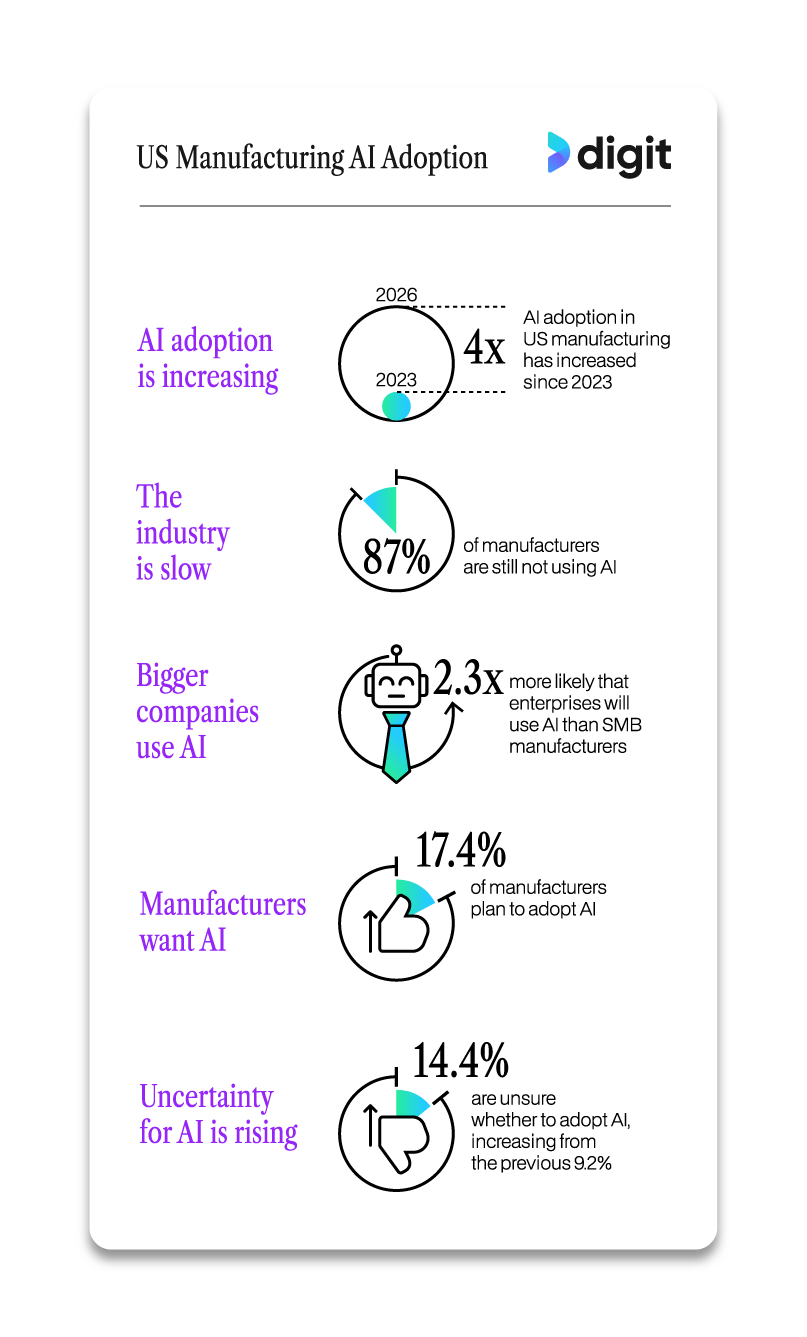
- 4× AI adoption in US manufacturing has increased since 2023
- 87% of manufacturers are still not using AI
- 2.3× more likely that enterprise manufacturers are using AI than SMB manufacturers
- 17.4% of manufacturers plan to adopt AI
- 14.4% are unsure whether to adopt AI, increasing from the previous 9.2%
Executive Summary
With AI becoming so prevalent in commercial and business applications, it wouldn’t be unreasonable to assume that AI will be widespread in the manufacturing industry.
However, the numbers paint a different picture.
AI adoption in US manufacturing is indeed growing, but the industry is still in the early stages of transitioning to this technology. Between September 2023 and February 2026, AI usage in any business function rose 12.1 percentage points, from 1.8% to 13.9%. Growth nearly doubled between 2024 and 2025, rising from 2.61% to 4.36%. However, planned adoption in late 2025 and early 2026 shows early signs of plateauing, meaning that the number of businesses with intentions to adopt AI is close to hitting a ceiling (see graph below).
At the sector level, the share of manufacturers using AI has been stable or increasing in 72% of survey periods, and has never fully reversed since it began climbing — suggesting the overall adoption trend is holding.
But even though AI is starting to find its footing in the manufacturing industry, 87% of manufacturers have not adopted it into their workflows.
While the rate of AI adoption has increased, so too has the uncertainty surrounding the tool. 17.4% of manufacturers plan to adopt AI, outpacing those already using it at 12.6%. This hesitation, combined with the episodic pace of adoption (we will cover this later), could be due to implementation friction and a lack of understanding of AI’s practical applications in a manufacturing setting.
Comparing this to other industries, McKinsey1 published a report indicating that 88% of companies intend to implement and use AI in at least one business function.
The reason for such a big gap between manufacturers and other businesses could be that AI integration is structurally easier for industries that don’t have manufacturing processes, such as finance, marketing, customer service, etc. Manufacturing has a lot more variables that need to be taken into consideration:
- Physical production environments
- Legacy machinery
- Tighter compliance requirements
So, even though it’s difficult to make direct comparisons with cross-industry averages, the gap exists. It can be interpreted as reflecting the complexity of the manufacturing industry, and with no clear use for AI in its workflows, creating a reluctance to adopt.
This report will detail the rate of adoption in US manufacturing, attempt to explain why and when manufacturers adopt AI, and offer some future predictions on the state of manufacturing and AI.
AI Adoption: Small Business vs. Enterprise
According to the data, although AI adoption in manufacturing is slower than in other industries, one factor strongly predicts whether a business adopts AI.
And that is the size of the business.
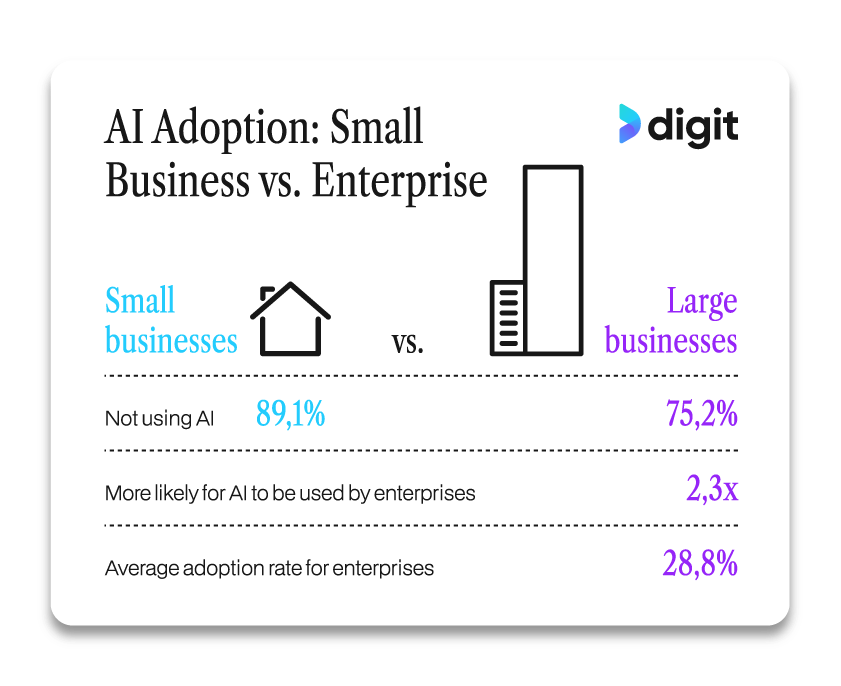
Larger manufacturers are 2.3x more likely to adopt AI than their small-business counterparts, and the adoption rate among larger businesses stands at 28.8%, suggesting enterprises are further along in their AI transition. It is worth noting that this gap isn’t unique to the manufacturing industry. According to a report published by the OECD2, larger firms were 3x more likely to adopt AI than smaller businesses. We will explore the reasons behind this gap later under the section: The Intention Gap and Hesitation to Use AI.
AI Adoption Is Episodic
As noted in the Executive Summary, AI adoption is stable or growing in 72% of transitions.
But that growth has been episodic rather than steady. For example, in 2025, the biggest single-period jump recorded was +2.73 percentage points in October, followed two months later by the sharpest pullback of –2.20 percentage points in December. These spikes were also present in previous years, with a growth spike in October and a drop in December. One possible explanation for this dramatic rise and fall is holiday sales, specifically BFCM campaigns:
- October: pre-sales — Demand forecasting becomes essential, sales and manufacturing orders increase, and optimizing inventory and supply chains becomes imperative
- December: post-sales — Holiday sales finish, vacations and downtime increase for the Christmas period, and there’s less organizational bandwidth to onboard new technology
These bursts of interest also align with information shared by Business Wire4, which reported that 65% of e-commerce executives surveyed had planned to adopt AI tools in their organizational workflows ahead of the holiday season — showing that Q4 adoption isn’t unusual for most industries, and we can expect to see a similar trend in 2026.
The Intention Gap and Hesitation to Use AI
Although enterprises are more likely to use AI, fewer than a third have implemented it in their workflows.
Which raises the question:
Why haven’t manufacturers adopted AI, and why are smaller businesses more reluctant?
17.4% of manufacturers plan to implement AI, outpacing the 12.6% already using it.
Across the entire measured period, this +2.3 percentage-point gap is consistently present, showing that more manufacturers are willing to implement these tools, but there’s always a gap between intention and actual implementation.
Several factors likely explain this gap.
One likely factor is the challenge surrounding training and onboarding, which is a larger issue for smaller businesses.
Introducing a new tool comes at the cost of downtime as staff are trained to use it, and a small business simply lacks sufficient justification to suffer these costs. Enterprises, on the other hand, will also want to avoid downtime, but they have the luxury of greater capacity, allowing them to pilot tools to help manage certain functions or operations without disrupting the entire business.
But, as already mentioned, the reasons for the slow adoption could be due to limited awareness of the benefits or organisational resistance. Slow adoption could have less to do with the technology and more to do with what happens inside organizations:
- Internal resistance due to the fear that automation will eliminate certain roles
- Caution over legal and compliance issues around liability, data privacy, and discrimination risk
- Lack of infrastructure to support AI, as enterprises tend to have custom-built in-house solutions
- Talent gap or untrained staff requires training and upskilling
E-commerce Platform Adoption by State
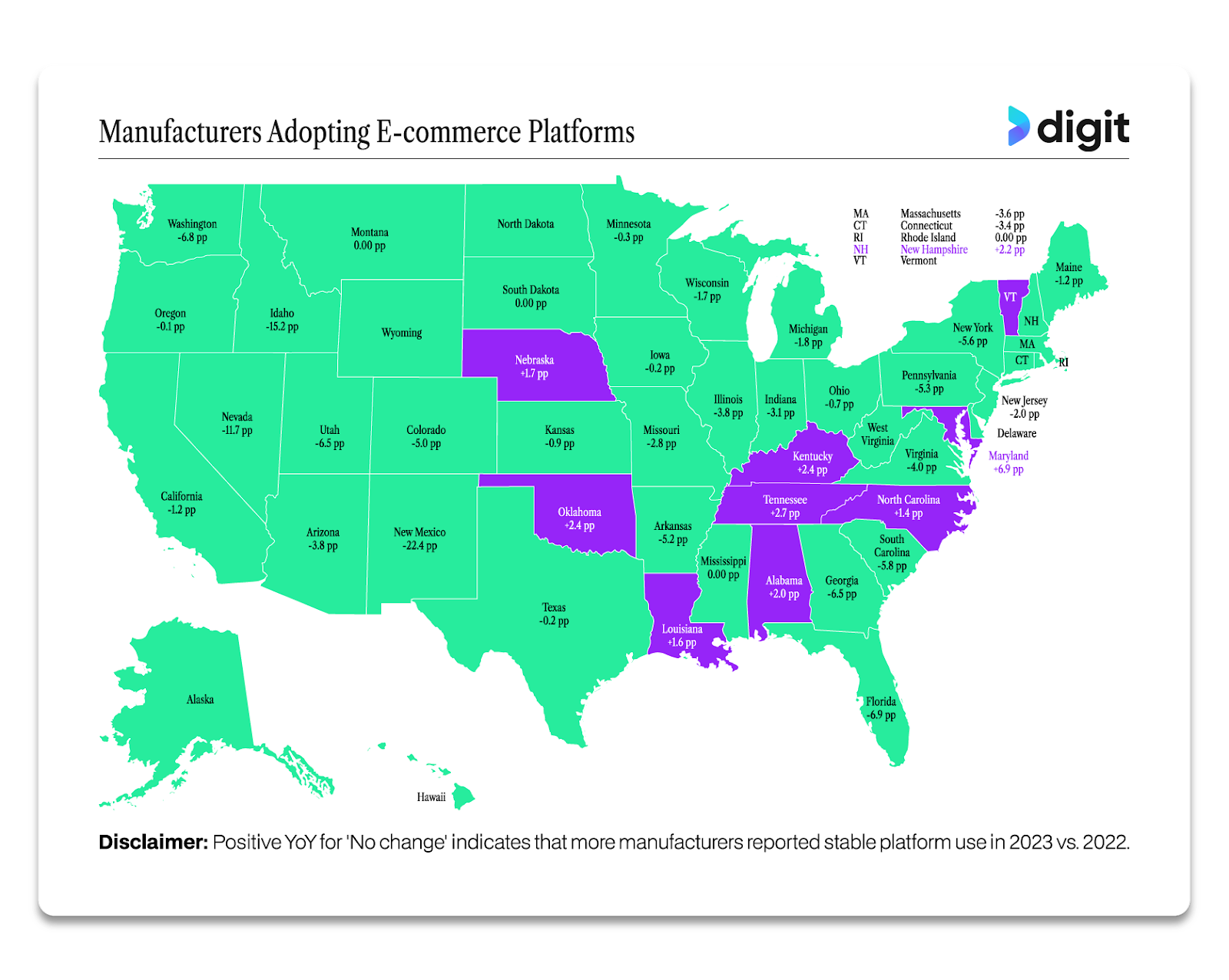
Beyond AI adoption, another interesting trend we noticed in the data was how manufacturers leverage online sales channels.
Between 2022 and 2023, 47% of respondents reported no change in online platform use, and only 4.4% reported an increase. What this data indicates is that the e-commerce adoption rate stabilized during this period, suggesting that most manufacturers aren’t actively seeking to digitalize their sales channels. This could also be another reason why AI adoption has been sluggish in this industry, since most businesses opt for manual or offline sales channels to distribute their goods, which makes it more difficult to integrate an AI solution into these workflows.
No Clear ROI on AI Adoption Creates Uncertainty
Another factor contributing to slow adoption is the lack of clarity about the tool's ROI.
According to an article from Fortune3, on the macro-scale, there hasn't been a particularly strong boost to productivity for most businesses, a phenomenon known as Solow’s productivity paradox, in which actual productivity growth slows despite predictions of significant gains due to a revolutionary new tool (in Solow’s case, it was the PC — in this case, it is AI).
A study published by MIT5 also supports this claim that the ROI hasn’t been justified yet.
This study found that 95% of generative AI pilots were unsuccessful in delivering fast revenue gains. When it’s almost guaranteed, at least in the short-term, not to make any significant impact on your profits, it’s difficult for a manufacturer, especially smaller ones operating on tight margins, to justify that investment on the hope of a long-term payoff.
Data shows that apprehension is rising among those who haven’t adopted AI yet.
Respondents answering “Do not know” when asked about using AI in their business have risen from 9.2% to 14.4% over the observation period.
This information doesn’t necessarily mean that those who haven’t adopted will never adopt — and the response could even indicate that manufacturers aren’t sure they’re using AI, since most software now includes some AI functionality.
Assuming the increase is due to uncertainty about how to adopt AI, competitive pressure will likely force adoption eventually (the same holds for any tech or innovation, such as the PC and social media). But, for the time being, either the lack of quantifiable success or the tech evolving too fast to even evaluate is creating more uncertainty over time.
Given how complex production environments can be and the risk of implementation going wrong on the factory floor, the unknowns surrounding AI are enough to give even willing manufacturers pause.
Trends and Predictions for 2026
Based on the data and broader market trends, here is what we expect to see for AI usage in 2026.
AI Adoption Will Continue to Climb — In every single measured period, planned adoption has outpaced current usage. As pressure from competitors adopting tools mounts, the cost of inaction will eventually outweigh the uncertainty and fear of being left behind. Another factor is that AI functionality will become increasingly present in SaaS products, and using AI won’t be optional.
Q4 Holiday Sales Will Be a Driving Force — October surge patterns suggest that manufacturers adopt AI in anticipation of holiday sales, and we will see this pattern repeat in 2026. Due to the huge increase in sales volumes during BFCM, manufacturers turn to software to help manage demand forecasting, inventory management, and supply chain tools, but with AI now being an option, more organizations will turn to AI to solve these challenges.
AI Won’t Make It to the Shop Floor — As OECD research noted, only 29% of SMEs use generative AI in their core activities. Until AI can handle the complex requirements of production, manufacturers will likely implement it for inventory management, scheduling, demand forecasting, and light-quality defect detection, but will still require human intervention, as they cannot afford mistakes in their manufacturing workflows.
Productivity Gains Won’t Be Overnight — As research and publications have pointed out, for many businesses and at the macroeconomic level, productivity gains have been small. While the returns have been minimal due to investments in skills, infrastructure, and organisational change, adoption of AI will eventually lead to a productivity J-curve as the gains compound over time.
Commercial AI Dominance Will Shift — In February 2026, the OpenAI Pentagon deal led to uninstalls surging by 295%6 and many users switching to Claude, following Anthropic’s refusal to accept the same terms, which made Claude the number one app in the Apple App Store and broke all-time sign-up records. Regardless of your opinions on the DoW (formerly DoD) using AI, each company's stance will likely lead to ChatGPT shifting toward government and defense contracts, while Claude will increase in popularity commercially and gain more market share.
Conclusion
Adoption of AI tech by US manufacturers is increasing, regardless of business size (though it is more prevalent among larger firms).
But that growth is slow and cautious, with the majority of manufacturers still not implementing AI into their workflows, and a trend of uncertainty about how to adopt it is emerging. Our prediction is that adoption is inevitable, as the intention gap shows the demand is there, and when periods of high order volume (such as during BFCM) arise, manufacturers will start to turn to AI solutions to alleviate the pressure.
What all manufacturers are currently missing is a clear problem to solve to move from planning to execution.
Eventually, even if a clear justification doesn’t emerge at the moment, as more and more competitors adopt AI tech, businesses will be forced to pivot to stay competitive.
Methodology
The State of AI Adoption in US Manufacturing Report primarily uses data from the US Census Bureau's Business Trends and Outlook Survey (BTOS)7.
The data collected and published by the US Census Bureau come from a cross-sectional survey that reveals adoption trends. The survey doesn’t track individual businesses over this time frame, meaning AI retention rates aren’t tracked for specific businesses, and new adopters, AI loyalists, and churned businesses cannot be distinguished. Another caveat worth noting about the data is that the survey questions changed in November 2025, and the scope was broadened from AI use in producing goods and services to AI use across any business function.
- Survey periods — July 2022 – February 2026, bi-weekly, 14 days each
- Sector — Manufacturing NAICS 31–33
- Size segmentation — 1–4 employees to 500+ employees
About Digit
Digit is a cloud-based ERP and inventory management platform that helps manufacturers digitize operations, automate workflows, and improve real-time production visibility.
Sources
1 The state of AI in 2025: Agents, innovation, and transformation, McKinsey & Company, 2025
2 AI adoption by small and medium‑sized enterprises, OECD, 2025.
3 Thousands of CEOs just admitted AI had no impact on employment or productivity—and it has economists resurrecting a paradox from 40 years ago, Fortune, 2026
4 New Report from Swap Commerce Reveals Executives Accelerating AI Adoption Ahead of Black Friday Cyber Monday Season, Business Wire, 2025
5 The GenAI Divide STATE OF AI IN BUSINESS 2025, MIT, 2025
6 ChatGPT uninstalls surged by 295% after DoD deal, TechCrunch, 2026
7 Business Trends and Outlook Survey, United States Census Bureau, 2026