



What Is Perishable Inventory?

Perishable inventory refers to any item, product, or service that depreciates over time to become unsellable or worthless.
The first thing that will likely come to mind is any food and beverages that expire after a certain period of time. But the definition of perishable inventory is applicable to a wide variety of things. For example:
- A floral bouquet wilting
- A market research report that is losing relevance
- Ticketed events, boarding passes, and hotel bookings
Essentially, anything with a finite window for use or sale is a perishable product or service. But for the purposes of this article, we will focus on inventory only (though services could be considered, such as sold goods under warranty).
There is also a term called perishable stock, which is often used interchangeably with perishable inventory, but the slight difference is that perishable stock focuses specifically on tangible goods. But nowadays, perishable inventory is the more commonly used term.
Now we know what is perishable inventory, what exactly makes something perishable?
The perishability of an item is influenced by a bunch of different factors:
- Time
- Temperature
- Humidity
- Light exposure
- Relevance
So, starting with the one that plagues both businesses and consumers, we’ve all had to throw away dairy products, meat, eggs, and fresh produce because they have reached their expiration date and are now likely unsafe or unusable.
Moving away from stinky, sulfur-like rotting products, there are also things that perish, like antibiotics and vaccines. Pharmaceuticals are often required to be stored under strict conditions and have an expiration date.
But some items lack similar predictability. Take electronics and technology, for example. Their value can decrease steadily or drop to zero at any point. When newer models are introduced, older models become obsolete.
Which brings us to the ultimate pain point of managing perishable inventory. Stocking perishable goods carries the risk of losing revenue and wasting investments, so unlike almost all other items, they need careful attention.
Otherwise, they will rot your business to its core.
5 Reasons Managing Perishable Inventory is Important

Managing any type of inventory is important, but like we already mentioned, perishable inventory is a beast that requires far more attention because of its time-sensitive nature.
Because you have an expiration date, you have a limited amount of time to procure, store, and sell your inventory before it loses all its value. If you don’t manage to sell your products before the expiration date, the loss is immediate and irreversible, and repeated mismanagement can lead to serious operational and financial issues for your business.
1. Protects Profitability and Reduces Losses
If it expires, it’s unsellable.
Now it’s sat on your shelf, eating into storage costs as you dispose of it. Effectively managing your perishable inventory helps ensure products are sold before they lose value, preventing spoilage and unnecessary write-offs.
2. Maintains Product Quality and Safety
Proper and appropriate inventory management is going to improve the longevity of a product by ensuring perishable inventory is correctly:
- Stored
- Handled
- Transported
Maintaining consistent quality and proper storage tactics will reduce defects, prevent contamination, and help you get products to customers fast and safely.
3. Reduces Recalls and Customer Complaints
Getting your perishable inventory management on point means fewer quality issues making it to market, ultimately reducing customer complaints and recalls.
Firstly, this will significantly lower direct costs associated with returns or recalls, but it will also help you preserve your brand reputation and maintain customer trust.
4. Improves Customer Satisfaction and Demand Fulfillment
Demand for perishable products and services is often urgent and time-dependent.
Efficient inventory management will help you meet demand, provide high-quality products, and avoid stockouts. Consistently meeting expectations builds customer loyalty, strengthening long-term relationships.
5. Makes Inventory Tracking Mission-Critical
We can’t drive this point home enough:
Tracking is a must because you are against the clock with perishable inventory.
Unsold, expired inventory results in total loss, making errors far more costly than with non-perishable goods. Implementing accurate tracking systems and establishing the healthy habit of regular audits will ensure that you’re:
- Reducing mistakes
- Identifying problems early
- Finding the root causes of waste or inefficiencies
11 Essential Strategies for Perishable Inventory Control
.jpeg)
So, perishable inventory can be the bane of your existence if you’re not on top of your management game here.
Now it’s time to figure out how to go about actually managing this formidable inventory type. In its essence, managing perishable goods is ultimately about matching supply and demand in both quantity and timing. You can’t just fill up your shelves in anticipation of orders, you need to have items on hand for exactly when customers need them, while avoiding excess stock that can expire and turn into a direct loss.
Here are 11 strategies to help you make sure you’re sending products to customers, not to the landfill.
1. Use FIFO to Keep Stock Moving
Starting with the tried-and-true inventory valuation method, FIFO (First-In, First-Out).
This method of stock rotation means the oldest stock received is the first used or sold, before newer stock. In many industries, FIFO mirrors how goods naturally flow through storage and is an effective way to reduce the risk of products expiring within your inventory.
2. Use FEFO When Expiration Dates Matter Most
Moving on to FEFO (First-Expired, First-Out), which prioritizes what will expire first.
You might be a little confused because why wouldn’t this be different from FIFO? Well, your suppliers are handling perishable goods too, and they are trying to ensure they don’t end up stuck with expiring stock. This means your latest order might expire before the stock you already have on hand, and it will need to be prioritized.
3. Track Inventory in Real Time, Including Expiration Details
Sure, you can stick to spreadsheets, but the speed at which an operation needs to move, a spreadsheet just is not going to be able to keep up.
Perishable inventory is completely dependent on accurate and up-to-date visibility, so this is why many businesses turn to inventory management software to better understand what is on hand, what is in transit, where items are stored, and which lots or units are closest to expiring.
If you have a capable system, you can easily answer practical questions such as how much inventory will expire next week or how many usable units you will have tomorrow. That visibility supports better ordering decisions and enables you to take action early. For example, if you can see that some of your inventory is very close to reaching its expiration date, you can run a promotion to recover part of your costs rather than write everything off.
4. Audit Regularly to Catch Errors, Waste, and Shrink
Your system will only be as good as the information that is input into it.
It’s nice to have everything digitalized and easily accessible, but in the real world, lots of things can happen which will affect the reliability of the system's data:
- Data entry mistakes
- Inconsistent portioning
- Damage
- Unrecorded waste
- Theft
You should view discrepancies as inevitable, so introduce regular inventory audits to ensure that the physical inventory is reflected in your records and to investigate gaps before they become costly problems later down the line.
If you’re handling goods that can degrade due to handling, temperature exposure, or transportation conditions, auditing is even more important to ensure the products you have are stored in the best possible conditions.
5. Forecast Demand So You Don't Overbuy or Run Out
Demand forecasting is always important, regardless of the type of inventory that you sell.
As always, with perishable inventory, demand forecasting will have to be fine-tuned. For example, let’s keep it simple, you own a restaurant. It’s midday, and the lunchtime rush comes and goes. If you haven’t anticipated how much food you needed for lunch time, you’re likely going to have to close early for the day because of a stockout.
Depending on your type of business, you may have to consider demand daily or even hourly.
This will come from trial and error, and software will make it easier, but you will have to pay close attention to historical sales data to identify seasons, busy days, peak hours, and special events that shift demand.
6. Organize Storage to Support Rotation and Temperature Control
Perishable inventory is like trying to care for a houseplant.
Unlike its wild relatives that can grow in the seemingly harshest of conditions, a house plant is highly sensitive to conditions such as:
- Temperature
- Humidity
- Light
The same goes for perishable goods. To reduce spoilage, consider creating dedicated zones (for frozen, refrigerated, and ambient areas) and placing your fast-moving or short-shelf-life items in priority locations that are easily accessible so they can be transported as soon as possible.
It’s also a good idea to set up quarantine or inspection areas for incoming goods, as well as designated spaces for rotation activities and waste sorting.
7. Standardize Processes and Train Staff
All your systems, strategies, and planning are only good if your people know what they’re doing.
To ensure that your staff know how to properly handle your goods, you will need to train them and create Standard Operating Procedures (SOPs) so everyone knows what they’re doing when:
- Receiving
- Labeling
- Storing
- Rotating
- Tracking
- Disposing
8. Use Technology to Make Control Easier and Faster
In the early days when you’re just getting your business up and running, it’s not unusual to use spreadsheets.
However, as operations scale, to slug it out with spreadsheets is to deny yourself from implementing technologies that can speed up inventory management as well as improve the accuracy of stock counts. For example, barcode scanning, RFID, and inventory platforms can capture movements automatically, maintain batch or lot visibility, and send reorder point notifications when inventory levels are running low.
9. Treat Safety Stock Carefully
A reorder point is the lowest possible threshold you can reach before you need to create a purchase order to avoid a stockout.
The remaining inventory is your safety stock, meaning you can keep selling while you wait for a delivery of new supplies. This is a fairly standard practice in most businesses managing inventory, but with perishable goods inventory management you will need to take into account the expiration dates of your safety stock too.
You’re going to need to weigh up the costs of a stockout vs. the cost of producing waste. For businesses managing food, that safety stock level is likely to be closer to zero than other forms of inventory.
10. Strengthen Supplier Relationships and Diversify Your Supply Chain
Keeping inventory stocked and goods moving is only going to be achievable with reliable supply partners.
This means finding several suppliers and staying on good terms with them, because your business is likely going to be reliant on short-notice purchase orders.
A strong relationship with your suppliers is going to reduce lead times and issues as it will lead to:
- Better communication
- More flexibility
- Better outcomes when something goes wrong
A great supplier will be someone who can understand your needs and help you plan more effectively.
But notice how we keep mentioning suppliers and not the singular supplier. The name of the game with perishable inventory is a diverse supply chain to reduce your dependence on a single source. When businesses approach diversity, they are looking for three things:
- Redundancy — Having backup suppliers
- Flexibility — Ensuring suppliers can adapt when your needs change
- Geographic spread — Avoiding heavy concentration in one region
While diversification can increase complexity and cost, it can be especially worthwhile for perishables because disruptions can destroy product value, and the only way to stay profitable and successful is to keep moving.
11. Build FDA and FSMA Compliance and Recall Readiness Into Your System
Many industries that manage perishable inventory operate in regulated sectors such as food and pharmaceuticals, and traceability will be a legal requirement.
In the United States, the Food Safety Modernization Act (FSMA), enforced by the FDA, requires businesses to shift focus from reacting to contamination events to actively preventing them. For perishable goods, this means your inventory system must be able to:
- Track ingredients and materials by lot or batch number
- Record production and expiration dates
- Maintain supplier documentation and certificates
- Trace finished goods back to original supplier lots
You will likely need to find and implement a system that tracks products at the batch or lot level, maintains detailed audit trails of inventory movements and handling, and can quickly identify affected units if a recall is required.
Batch and Lot Tracking for Complete Traceability
.jpeg)
We want to talk a little more about point 11 from the previous chapter, because you’re going to have to implement a solution or tool to successfully manage perishable inventory.
And to be compliant and recall-ready, you’ll need batch and lot tracking. These functions will assign unique identifiers to groups of products made under the same conditions, such as:
- The same production run
- Ingredients used
- Equipment used
- Date manufactured
The purpose is to record data to support bidirectional traceability (forward and backward). Having this historical data is what sets traceability tools apart from a solution that can only do stock takes. So, when an issue arises anywhere along the supply chain, you and your team can quickly determine exactly where the problem originates using the information tracked by the traceability solution. This will allow you to resolve these problems, improve efficiency and profit, while having the evidence to demonstrate to regulators that you’re capable of tracking all your items should the need to prove that come up.
Traceability software comes in all different shapes and sizes, supporting either your entire business or just a certain department or function within your operations.
For example, ERP or WMS platforms help centralize batch data, reduce human error, and maintain visibility across locations.
There are also different tracking methods, so when choosing a solution, be sure to pay close attention to their features to be sure that they can support your specific needs. This is because batch and lot traceability track groups of identical products, while serial numbers track individual units, usually high-value or warranty-sensitive ones.
Digit — A Solution for Perishable Inventory Management
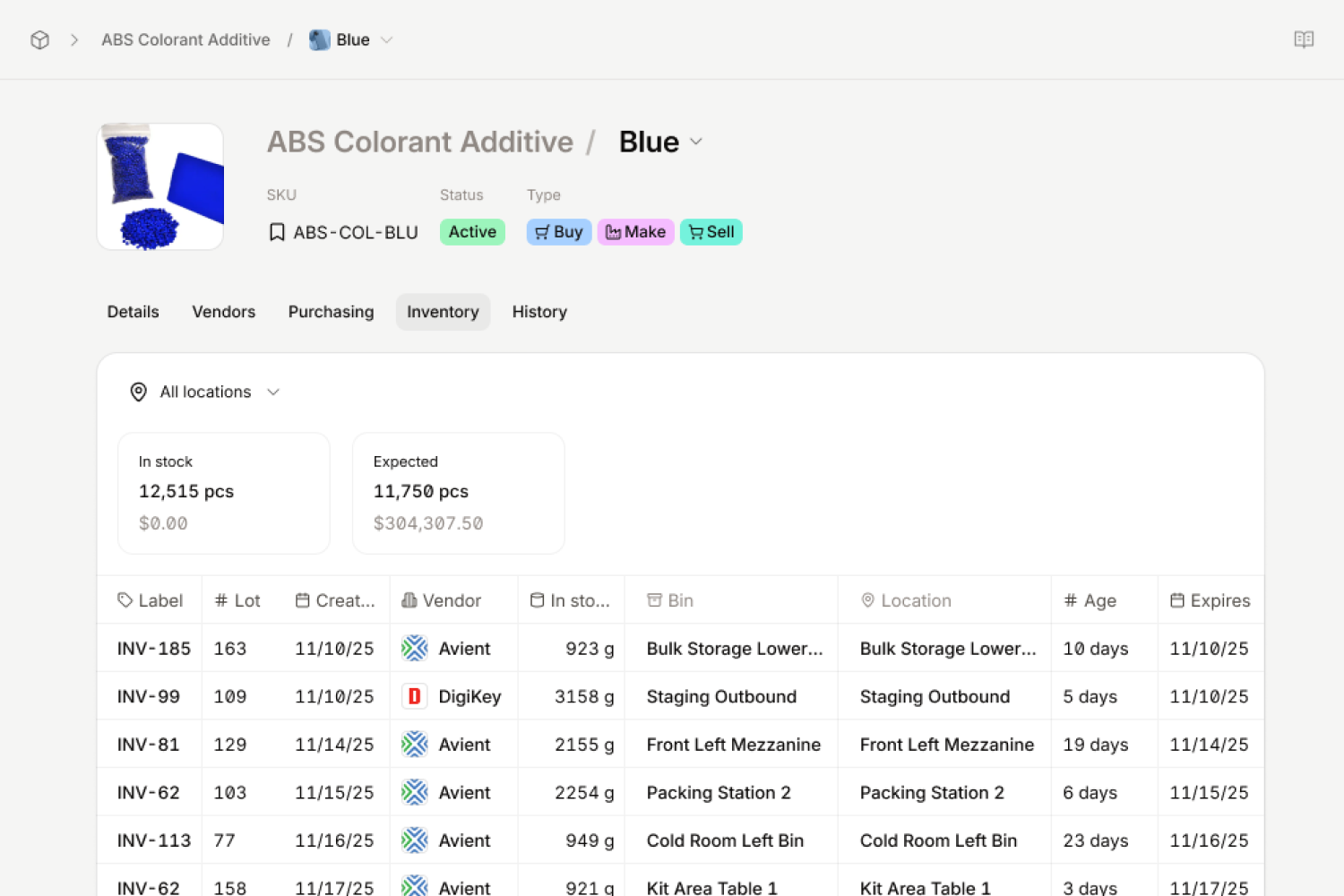
Digit helps teams manage perishable inventory by connecting purchasing, inventory, production, and fulfillment in one system.
Instead of jumping between different solutions or spreadsheets, Digit gives you real-time visibility into:
- Stock levels
- In-transit ingredients and goods
- Storage and bin locations
- Expiration dates
End-to-End Traceability for Batches and Items
Digit is built to give you end-to-end traceability of your perishable inventory.
It does this by linking your purchase order receipts to production runs, finished products, and sales orders, so every batch and item has a searchable, auditable history throughout its lifecycle.
Batch, Lot, and Serial Tracking
As mentioned before, you need to be careful to check if a solution has the features you need to support inventory types, and with Digit you don’t have to worry as it supports batch, lot, and serial number tracking.
Batch and lot tracking will help you and your team trace the origin of materials, how they were used, and where finished goods were shipped. And if you have higher-value items or tightly regulated products, Digit supports serialized inventory, so each individual unit can be tracked with its own unique ID.
Real-Time Inventory Control and Expiration Monitoring
Digit updates inventory levels in real time across multiple:
- Warehouses
- Locations
- Bins
You can easily set reorder points and receive email alerts to prevent stockouts, while also tracking shelf life and expiration dates to avoid increasing carrying costs by being stuck with something that is no longer sellable.
Compliance, Documentation, and Recall Readiness
If your business operates under regulatory frameworks like FSMA, Digit has you covered. Digit has built an intuitive document management system, so you can easily stay compliant by tracking lot numbers, recording expiration dates, and maintaining supplier documentation automatically.
You or your team can upload certifications, COAs, SDSs, test results, and quality checks, attaching them directly to batches, orders, and even items. You'll have a clear audit trail from the supplier through production and to the customer. So if a recall happens, you can quickly identify and isolate affected units without scrambling through spreadsheets.
Industries Digit Serves and How It Supports Them
Different industries require different means of tracking, documentation, and real-time updates, and Digit is built to be flexible to fit into your specific production and supply chain requirements.
- Food and Beverage — Track ingredients, manage recipes and BOMs (either single or at the multi-level), plan production, and maintain accurate stock counts across all your inventory and manufacturing locations. Lot tracking and real-time barcode scanning enable you to support shelf-life control, compliance readiness, and faster investigations if a problem happens anywhere along your supply chain.
- Cosmetics and Beauty — Cosmetics manufacturers like to use Digit (for somewhat similar reasons as F&B businesses) to manage formulas, ingredient sourcing, and batch production while maintaining consistency across production lines. Real-time tracking and documentation help them stay on top of their compliance requirements and make recalls more targeted if a specific batch needs to be isolated from the rest of the perishable inventory.
- Chemicals and Pharmaceutical — When it comes to chemical and pharmaceutical operations, they take advantage of the same features, such as tracking raw materials and finished goods by lot, monitoring expiration and retest dates, and maintaining documentation like SDSs and test results.
Electronics and High-Value Manufacturing — For electronics and other high-value goods, Digit supports serial number tracking, multi-level BOM control, and detailed production records, to help you implement component traceability, manage rework and quality inspections, and keep documentation ready for audits.
Digit isn’t only limited to the above industries, and has seen practical and successful implementation into a wide range of businesses.
Want to see for yourself? If you’re managing perishable inventory and are struggling to get items out the door before they expire, you can see what this looks like in our AI demo.
But otherwise, that’s it! We hope you enjoyed this deep dive into perishable inventory, and if you have any questions about Digit, feel free to get in touch.

%20(2).jpg)