



What Is a 3PL Warehouse Management System (WMS)?
%2520(1).jpeg)
A 3PL Warehouse Management System (WMS) is software built specifically for third-party logistics providers who need a solution to not only handle multiple clients, but also their:
- Inventory
- Orders
- Fulfillment
The life of a 3PL business is a complicated one. They suffer the same problems as any business that manages and sells physical goods, but a 3PL's challenges are exacerbated, multiplied by the number of clients they work with. To avoid losing their sanity, many 3PLs turn to WMS solutions to centralize and track warehouse operations while keeping each client's data, rules, and visibility entirely separate.
The ultimate purpose of a 3PL WMS is to give its users the ability to:
- Handle larger volumes of orders without having to increase the workforce and avoid errors as they scale
- Enable easier client onboarding by configuring client-specific rules within the same system used to manage all other client data
- Maintain great and consistent service levels across all their client accounts
Why Is It Important to Have 3PL WMS Implemented?

With every new client you bring into the fold, a new and unique set of demands comes with them that needs to be managed:
- Custom SKU catalogs
- Different handling requirements
- Unique SLAs
- Billing models
For each client, it’s basically like managing the responsibilities of a new business, and doing so manually is a hassle. Many 3PLs try to do so at first. They will manage with spreadsheets or pen and paper, but the cracks appear quickly, and here’s how they slowly start to cripple your operations.
Inventory Accuracy
Doing things manually means sacrificing real-time updates.
Sure, you’ll save some money by avoiding the costs of using the software. But those savings are quickly lost to:
- The time it takes to locate products in your warehouses
- Overselling because you miscounted inventory levels
- Inventory shrinkage accumulating over time
According to the CAPS Research report, high-performing warehouses regularly achieve 91%+ accuracy, while operations without a proper WMS can see that figure drop to 65%.
Fulfillment Speed and Accuracy
Every time an order is ready to be fulfilled, without software, you print off the work order and send it off to the void, with no way of knowing the progress without just going down to the warehouse and asking around.
Without a system, your picking, packing, and shipping workflows become reliant on paper-based processes or, even worse, tribal knowledge. This will inevitably lead to:
- Climbing error rates
- Delays in shipments
- Rising labor costs
And while you’re running around trying to fix these issues, your competition is running ahead by having taken the time to implement a solution.
Client Trust
The very nature of a 3PL setup means that clients will be essentially placing you in charge of their entire business.
Messing up on your end will cost them time, money, and their brand reputation. For this reason, and because the technology is becoming more widely available, clients expect real-time access to their stock levels and order status. If you’re unable to provide this information, you’ll need to have calls or email exchanges where you’ll need to sift through and share information from spreadsheets or other documents to answer basic questions.
That friction damages confidence, and clients begin looking elsewhere.
Profitability
3PLs often provide value-added services like:
- Kitting
- Relabeling
- Specialized packaging
All of which will be very easy to lose track of when teams log them manually.
According to a report published by Extensiv, 56% of 3PLs say they leave money on the table because they cannot automate billing for these services. This means that you spend time and do this work, just for no one to charge the client for the extras.
And even invoicing and billing in and of itself becomes a time and money sink.
Over half of 3PLs spend more than 16 hours a month on billing, while those who keep it under 8 hours are 2.8x more likely to be highly profitable.
Integrations
Doing things manually means that your warehouse operations are siloed.
Without a WMS, you’re not going to be able to link and connect to your order management systems or sales channels, and you and your team will be left manually reconciling inventory across tools, working around slower order turnaround, and operating without a clear picture of fulfillment status.
In Japan, this is called “Muda” and not addressing the issue of visibility is adding no value and increasing costs for both you and the customer.
The Key Benefits of a 3PL Warehouse Management System

So, now you know just what you’re turning your back on when you don’t implement a 3PL WMS.
But let's explore these benefits in more depth, from the warehouse floor to the client relationship.
Accuracy and Efficiency Improve Immediately
Barcode scanning and RFID technology remove the manual touchpoints where errors tend to accumulate — in inventory counts, order picking, and shipping.
The result is fewer mis-ships, fewer costly corrections, and a more reliable operation overall.
Clients Get the Visibility They Expect
A 3PL WMS system gives each client secure, real-time access to their own inventory levels and order status through dedicated portals.
This removes the back-and-forth of manual reporting and builds the kind of transparency that strengthens long-term relationships.
Billing Becomes Accurate and Automatic
Every storage movement, pick, pack, value-added service, and handling activity is tracked and invoiced automatically against the correct client.
This eliminates revenue leakage and frees up the significant administrative time that manual billing typically consumes.
The Operation Scales without Breaking
Whether onboarding a new client, absorbing a seasonal spike, or expanding into new warehouse locations, a 3PL WMS system accommodates growth without requiring a system overhaul.
Capacity expands within the same platform, and client-specific rules scale alongside it.
Data Supports Better Decisions
WMS for 3PL surface insights on labor allocation, inventory placement, and order patterns that would be impossible to extract manually.
Over time, this intelligence allows 3PLs to optimize how their warehouse runs rather than simply reacting to what's happening in it.
11 Requirements You Should Look Out For In A 3PL WMS

So, you now understand its importance and the benefits of ditching inefficient manual processes and getting set up with something that can help you manage your 3PL workflow.
But not all warehouse management systems are built for the demands of a 3PL environment. When evaluating options, the following requirements should guide your decision.
1. Multi-Client Architecture
You’re abandoning manual processes because they’re reliant on workarounds — make sure you’re not getting set up on software that requires workarounds too.
You need a system that can easily separate client information in one place, so you can easily manage their:
- Inventory
- Orders
- Billing
- Reporting
To effectively manage each client, you should have configurable workflows, labeling rules, and SLAs that can be set up and modified without the vendor having to step in or you doing so with some cumbersome workaround.
2. Flexible, Automated Billing
Look for a system that can model the full complexity of your pricing contracts:
- Storage by pallet or cube
- Handling fees
- Value-added services
- Minimums
- Exception charges
If you're using a system that can't accurately reflect how you charge clients, it will erode margin regardless of how well the warehouse runs.
3. Multichannel Fulfillment Support
You’re likely going to have to manage orders from clients from multiple sales channels, so it’s a good idea to find a solution that can manage your different points of sale.
This means, regardless of sales orders and the types of orders, your system is managing inventory, regardless of how and where it’s shipped, giving you one space to manage and handle:
- DTC orders
- Bulk retail shipments
- Social commerce
4. Fast Partner and Client Onboarding
Speed of onboarding directly affects revenue.
The ability to quickly spin up new clients, SKUs, and billing configurations (without lengthy configuration cycles or vendor involvement) is a meaningful competitive advantage when clients are making partner decisions based on how quickly they can receive their first shipment.
5. Carrier and Mode Selection
A well-integrated 3PL WMS should connect to your carriers and surface available modes and rates on a single dashboard, giving your team the information to make fast, informed decisions on price and transit time.
Some systems automate this entirely through rules-based selection, while others rank options and present recommendations before you make the final call. Which approach suits you depends on how much control your team wants to retain over routing decisions.
6. Seamless Enterprise Integration
Nowadays, businesses are using several tools to manage their business, so it’s always a good idea to think about where this 3PL WMS will exist in your workflows and if it’s a good idea to integrate it with your other tools.
In our opinion, the answer is almost certainly yes most of the time. Ultimately, an integrated system will help you manage your entire business from one place, meaning a frictionless experience between your:
- EDI
- ERP systems
- Order management platforms
- Shopping carts
- Accounting software
- Analytics tools
The list of tools and functions you can potentially integrate is essentially limitless, but it will all depend on your specific operations. Perhaps you and your team prefer importing from Excel and uploading data to your 3PL WMS when updates are needed, or perhaps you all want a robust API for real-time data flow and internal reporting.
Cloud-based WMS systems tend to offer broader e-commerce integration natively, but a well-specified on-premise solution can meet the same needs.
Regardless of whether you go cloud-based or decide to go big with an expensive, on-site, custom-built solution, the system should eliminate manual reconciliation across platforms.
7. Ownership Transfer and Chain of Custody Tracking
This is going to be a super important functionality you need from your 3PL WMS solution.
As inventory moves between owners and businesses, at each handoff, you need to document and share information such as:
- Liability
- Insurance
- Compliance implications
This means finding a tool that can record receipts clearly and capture exactly when goods are accepted. If any complications arise along the supply chain, you will be able to see all inbound and outbound processing in one place, providing transparency and accountability for you and your clients.
8. Scalability Without Disruption
If you’re doing things the good old-fashioned way, struggling with spreadsheets and other manual processes, growth (be that new clients, warehouse locations, or order volumes) diminishes your capacity and requires you to hire more or figure out a way to free up capacity.
Implementing a WMS for 3PL will help you scale more effectively without changing or reconfiguring your existing workflows.
9. AI and Predictive Analytics
AI is everywhere, and regardless of your opinions on it, it’s only a matter of time before you're going to have to figure out how to utilize it yourself.
And if you haven’t started considering it, you might as well keep an eye out for it with your WMS for 3PL. Many vendors are incorporating machine learning into their tools to better:
- Anticipate demand shifts
- Optimize inventory placement
- Flag bottlenecks before they affect operations
If you or your team are worried about AI stealing jobs, it’s not quite at that level (yet). The purpose of AI is to support your decision-making. AI isn’t infallible, and its output isn’t supposed to be treated as gospel — its job is to take information and make it easier and quicker to understand.
10. Security, Compliance, and Audit Capability
When dealing with multiple clients, if security and traceability aren’t up to par, you’re going to be in a lot of trouble if a worst-case scenario happens.
Because you’ll have multiple clients' data stored in a single platform, be sure to research and find out if the solution you would like to implement has:
- Robust access controls
- Audit logs
- Data retention policies
These are essential requirements for managing your own risk and maintaining client trust.
11. Implementation Speed
Last but certainly not least — implementation speed.
When you've found the right system, the last thing you want is to spend months getting it set up and everyone onboarded.
Implementation time is going to cost you time and money, and different systems require different amounts of each. Make sure you’re looking at solutions that can get you up and running in the quickest amount of time without sacrificing the other 10 requirements listed in this article.
What Features Should You Look for in a 3PL WMS?

Once you know what your operation needs, the next step is to understand which features actually deliver on those needs.
Here's what a purpose-built 3PL WMS should include.
Multi-Client Architecture and Customer-Specific Workflows
Every client in your warehouse has:
- Unique storage conditions
- Fulfillment rules
- Picking strategies
- Reporting requirements
A 3PL WMS should allow you to configure all of these per client (like priority order rules, custom inventory allocation methods, temperature-sensitive handling) without those configurations interfering with each other or requiring workarounds that slow your team down.
Automated Billing and Reconciliation
Billing in a 3PL environment is inherently complex.
Storage duration, pick-and-pack fees, handling charges, courier surcharges, kitting, pallet rebuilds… all of it needs to be tracked and invoiced accurately to the right client.
A WMS should be able to automate this end-to-end, pushing draft invoices directly into your accounting software for review rather than requiring manual number-crunching at month-end.
Equally important is billing reconciliation. The ability to upload a carrier invoice and automatically check it against your contracted rates and what you billed your client. This single capability can protect a significant margin that would otherwise quietly disappear.
Real-time Inventory Tracking Across Locations
Every stock movement (receiving, putaway, pick, pack, shipping) should be recorded instantly.
This means accurate on-hand quantities, location-level tracking down to bin and zone, lot and serial number control where compliance requires it, and clear visibility into available, allocated, and on-hold inventory across multiple fulfillment centers.
When a client runs a flash sale, and inventory starts moving fast, the system should update availability across all connected channels in real time.
Client Portals and Visibility Tools
Each client should have their own secure login or customer portal, so there’s no need for back-end admin rights or calling your team for updates — they can easily do so themselves:
- Check live inventory
- View order status
- Upload purchase orders
- Access billing history
- Retrieve documents
Custom dashboards and automated reporting reduce the manual effort required to keep clients informed and strengthen transparency, which retains them.
Seamless Integrations
A 3PL WMS needs to connect cleanly with:
- ERP systems
- E-commerce platforms
- Marketplaces
- EDI feeds
- Shipping carriers
- Accounting software
When a client sells DTC on Shopify and wholesale through EDI, the system should ingest both order streams, apply the correct picking logic, and route them through the appropriate packing and labeling workflows automatically.
As clients expand into new channels, the WMS should be flexible enough to handle the additional channels without requiring workflow rebuilds.
Advanced Order Workflows and Automation
Intelligent order batching, wave picking, barcode scanning at every step, exception handling, and automated carrier selection all reduce errors and remove manual decision-making from routine tasks.
Rules-based automation is especially valuable at scale. You should find something that can automatically reroute orders when inventory drops below a threshold, or enforce retailer-specific labeling requirements without manual intervention.
Custom Documents and Labels
Labeling and documentation requirements vary widely across clients and industries.
Large retailers like Walmart and Amazon require specific label formats such as GS1/UCC-128 and SSCC. A WMS for 3PL should generate compliant labels automatically, alongside:
- Branded packing slips
- Custom invoice formats
- Region-specific documentation (where needed)
Labor Management and Performance Tracking
Labor is one of the highest costs in any warehouse operation.
A WMS with built-in labor visibility (like productivity by associate, task time measurement, workload balancing, capacity forecasting) gives you and your managers the data to adjust staffing based on:
- Real order volume
- Training gaps
- Slotting inefficiencies
Without this visibility, staffing decisions are guesswork, and service levels during peak periods become unpredictable.
Reporting and Analytics
A 3PL WMS should surface actionable insights, not just raw data.
Inventory turnover, order accuracy rates, on-time shipping performance, return rates by SKU, and client-specific dashboards all support the kind of strategic conversations that elevate a 3PL from a fulfillment vendor to a genuine operational partner.
How Much Does a 3PL WMS Cost?

So, as we have iterated throughout this article, a WMS for 3PL comes in all different shapes and sizes.
And even how the vendor provides the software will affect the pricing. WMS pricing varies enormously depending on the scale and complexity of your operation, and it's worth understanding the full picture before you start evaluating vendors.
We’re going to base these numbers on rough estimates, so they shouldn’t be treated as exact calculations, but more like a general guide:
- Entry-level cloud-based systems — Designed for smaller or simpler operations, typically cost $300 to $1,200 per month.
- Mid-market platforms — That support multi-client operations, multiple warehouses, and deeper integrations generally fall between $1,500 and $6,000 per month.
- Enterprise-level systems — Built for high-volume, highly automated, or multi-site operations can range from $7,000 to $30,000 or more per month, with the most complex global deployments running significantly higher still.
But, just to be clear, final pricing is always negotiated based on your specific operation, and the factors that move the number most are:
- The number of warehouse locations
- Order volume
- Number of clients
- Required integrations
- The level of automation your operation runs
But keep in mind, there are costs that go beyond simply paying for the software.
Implementation Costs Are a Separate Line Item and Often the Largest One
Depending on complexity, initial setup, data migration, system configuration, and testing can range from $15,000 for a straightforward mid-market deployment to $300,000 or more for a large enterprise rollout.
Integration work (such as connecting to ERPs, carriers, e-commerce platforms, or automation equipment) adds further cost on top of that, typically ranging from $10,000 to $80,000 depending on complexity.
Hidden Costs Are Where Budgets Most Often Get Surprised
The figures that don't always appear on a vendor quote include:
- Staff training time and the temporary productivity dip during transition
- Hardware upgrades like RF guns, label printers, and scanners
- Ongoing integration maintenance as platforms update
- Additional user licenses as your team grows
- Premium support tiers if you need priority access or dedicated account management
Asking vendors about all of these upfront will give you a far more accurate picture of the total cost of ownership than the subscription fee alone.
Cheaper Isn’t Always Cheaper
A lower monthly fee can quickly become more expensive when you factor in:
- Limited automation
- Poor integration stability
- Weak reporting
- The cost of eventually migrating to a better platform
For 3PLs running multi-client operations, the operational costs of a system that can't keep up tend to outweigh any savings from licensing.
When evaluating ROI, the most useful frame is the savings the system generates rather than its costs. Think about how the system is going to improve and optimize:
- Labor hours
- Billing
- Revenue from onboarding and retaining more clients
And there you have it, everything you need to know about the 3PL WMS, as well as a handy guide for determining what you need and how much you should consider having to spend.
But, if you’re disheartened by this section on costs, there are ways to get set up with a WMS without the need to spend so much money (and maybe even require a bank loan, looking at some of the costs…)
Managing Your Warehouse Shouldn't Require an Enterprise Budget
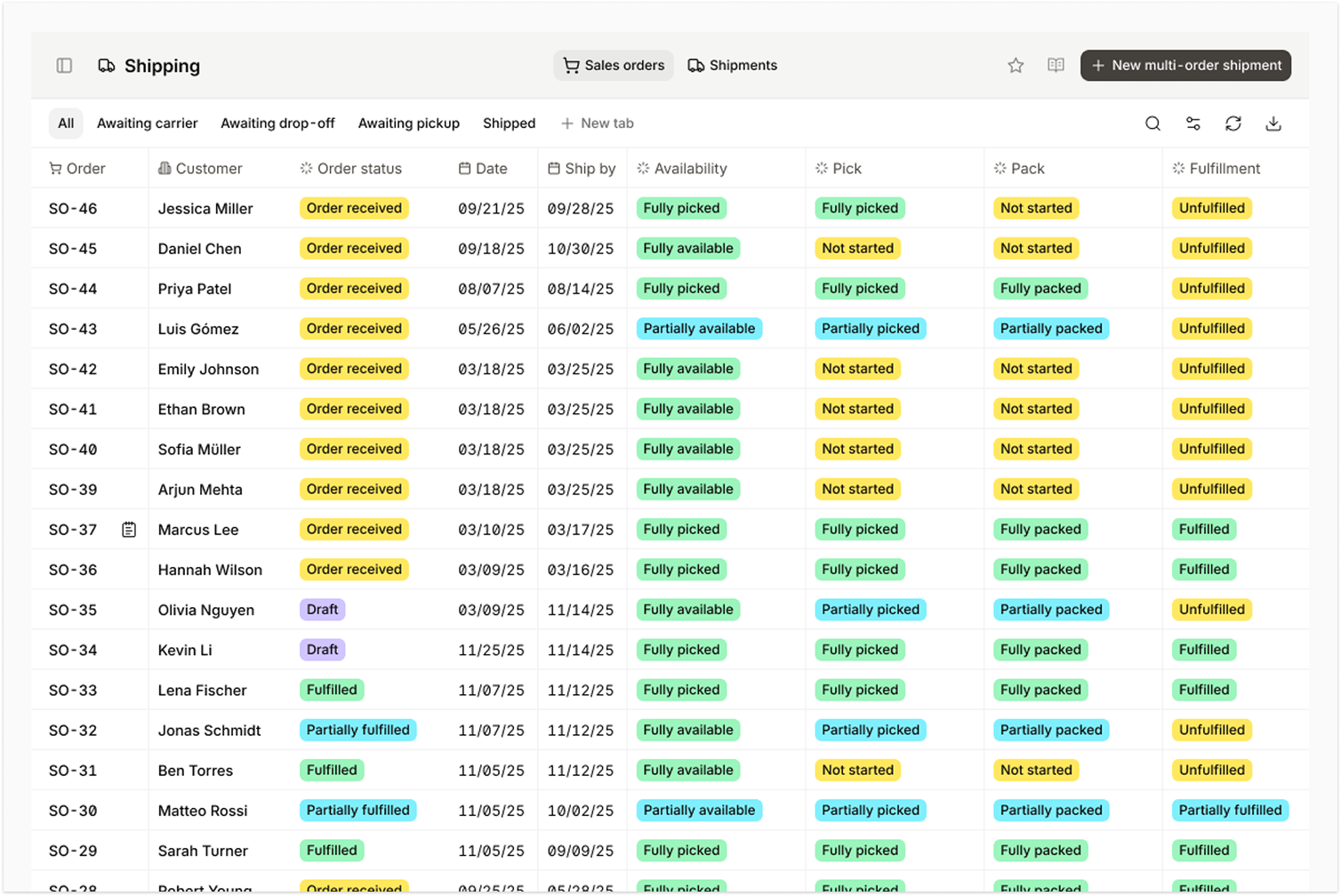
3PLs, manufacturers, and distributors — they are all familiar with the pains that a warehouse can bring.
The biggest being that manual management solutions in these types of businesses don’t last long, given the complexity of their supply chains. Just a couple of clients and already the manual processes start to buckle under the pressure. This is because:
- Inventory is spread across multiple locations
- Orders come in through multiple channels
- Teams end up wasting time trying to understand spreadsheets, standalone inventory tools, and accounting software that aren’t integrated
If this sounds like a problem that is starting to affect your business, it could be time to give Digit a try.
Digit is a cloud-based platform that brings all your important data into an intuitive platform, so you can see and easily manage your:
- Inventory
- Warehouse management
- Purchasing
- Production
- Order fulfillment
Digit helps you manage your entire business, without any workarounds or huge price tags, and best of all, you can be up and running with Digit within 30 days.
The moment an item is received, created, or shipped, inventory updates in real time across all your locations and sales channels, so you have accurate, up-to-date inventory levels as items move. And it doesn’t stop there. Digit also includes:
- Barcode scanning
- Bin-level tracking
- Batch traceability
- Demand forecasting
- Automated document generation
All of which are usually add-ons reserved for higher tiers by other vendors.
For teams that have hit the ceiling of what spreadsheets can handle but aren't ready to commit to cumbersome and overkill systems like NetSuite, Digit offers a practical middle ground: Enterprise-grade warehouse 3PL capability at a scale and cost that actually fits a growing operation.
Want to see for yourself? Try Chatting with Digit's free AI Demo to see how it can help you manage your business and important client information in one place.