



What Is B2B Wholesale?
Visual input: A large commercial warehouse with rows of tall metal shelving units stacked with shrink-wrapped pallets of boxed goods.
B2B wholesale is the sales tactic of selling products in bulk between businesses.
There are multiple ways in which a B2B wholesaler can acquire products to sell, typically by purchasing finished goods in large quantities from manufacturers. Once they have purchased goods in bulk, the B2B wholesaler will store them in their own warehouses, and sell those products in smaller batches at discount prices to:
- Retailers
- Distributors
- Other businesses
Unlike businesses that sell directly to consumers, a B2B wholesale strategy focuses on high order volumes and larger average order values. As already mentioned, this is ideal for the buyer because this usually results in lower costs per-unit bought, while the wholesaler benefits from moving large quantities of inventory at once. The benefits also extend to the supplier, as doing business with a B2B wholesaler simplifies the supply chain, allowing manufacturers to focus on production while wholesalers handle:
- Storage
- Distribution
- Logistics
B2B wholesale plays a key role in many industries.
For example, let’s explore the world of books. A book distributor supplies a bookstore with inventory at prices well below the listing price. That bookstore can then take those products and resell them to consumers at retail prices, earning a profit while relying on the wholesaler for consistent supply.
However, it doesn’t have to be goods that are for resale that are offered by the wholesaler, as it could include items that are necessary for operational or production use. To use the bookstore example again, those could be printing paper for receipts.
Types of B2B Wholesale Models

Visual input: Two staff members on a warehouse floor reviewing a tablet together, one in logistics workwear and one in business casual.
So, wholesale sounds pretty straightforward, right?
Well, in the words of Arnold Schwarzenegger talking to that one bad guy in the movie Commando — wrong!
While all wholesale models focus on selling goods in bulk to other businesses, the structure and execution can vary significantly.
Product-Based B2B Wholesale Marketplaces
This is the model that is likely to come to mind when you think of a wholesale setup.
This method typically involves the exchange of physical goods on a marketplace that connects manufacturers, distributors, or wholesalers with business buyers such as retailers or enterprise customers. These types of platforms function similarly to any e-commerce site, but the difference here is that it is designed for:
- Bulk purchasing
- Negotiated pricing
- Repeat orders
In this marketplace, sellers will list their products and display any relevant information, and buyers can browse and compare suppliers to find and negotiate better deals.
Procurement and RFQ-Based Wholesale
Where marketplaces show sellers advertising to buyers, a procurement-focused wholesale model operates as a reverse marketplace.
First, RFQ means Request for Quote. So here, buyers post asking for suppliers to help them find what they need, and include details such as:
- Quantity
- Technical standards
- Delivery timelines
- Budget constraints
And then the B2B wholesalers or suppliers will submit quotes to the buyer based on whether they're able to meet those requirements. This model is fairly common in industrial wholesale, manufacturing components, and custom or large-volume orders where pricing and specifications vary by deal.
Supplier-Operated Wholesale Platforms
Marketplaces are where you find multiple suppliers, but you can often skip going to the marketplace altogether and go directly to the manufacturer or wholesaler via their own e-commerce platform.
Selling through your own managed channel gives you full control over pricing, customer relationships, branding, and inventory visibility.
Supplier-operated platforms are often used by established wholesalers with extensive catalogs and recurring buyers, allowing them to support:
- Custom pricing by customer
- Contract-based terms
- Account approvals
- Direct integration with inventory management systems
This approach will be more expensive than using a marketplace and will require an upfront investment and operational responsibility, but it offers stronger margins and the tools to manage long-term wholesale relationships.
Hybrid and Omnichannel Wholesale
If you visit any blog on the web that tells you anything about or to do with business, you’ll likely see the word leverage — and here’s the moment we need to bust this word out.
For most businesses nowadays, it’s not a matter of choosing the marketplace or building your own store, it’s a matter of doing both. B2B wholesalers increase their reach and visibility by selling through their own e-commerce sites, participating in third-party marketplaces, and maintaining traditional sales rep relationships.
But, taking a hybrid wholesale approach obviously comes with you needing to carefully coordinate:
- Inventory
- Pricing
- Customer experience
And even though it requires a lot more effort for management, the omnichannel approach allows for greater flexibility and resilience as wholesale buying behavior continues to evolve.
And there you have it, all the different B2B wholesale models. We should warn you, however, that it’s not a matter of choosing one model or the other. The right structure for you depends on:
- Product type
- Buyer expectations
- Operational capacity
- Long-term growth goals
7 Benefits of B2B Wholesale

So, you know what B2B wholesale is and what you can do to get your products in front of potential buyers.
Why even do it in the first place, though? Surely it’s better and easier to just sell products individually and increase your profit margins. Well, there are several advantages for manufacturers, distributors, and wholesalers.
And here are seven of them to get you started.
1. Higher Average Order Value and Sales Volume
Once you’re able to sell to one client, there’s a high likelihood that they will reorder from you again on a regular basis.
What this means for you is that your average order value will be much higher than that of B2C businesses. And having clients place repeat orders means getting yourself set up in a long-term buying relationship, helping to improve revenue stability and lifetime value.
2. Faster Market Expansion
Taking advantage of wholesale channels helps you enter new markets without the need to build a large sales force.
Marketplaces mean the audience is already there, and the same is true if you can secure a contract with a retail partner. Finding a partner to do business with is even better, since they will have customer bases and local market knowledge, giving you the opportunity to scale nationally or internationally with lower risk and faster adoption.
3. Lower Operational and Marketing Costs
Selling in bulk is one of the easiest ways to simplify logistics and order fulfillment, meaning not only can you get stuff off your shelves in one go (potentially), but you can also reduce per-unit shipping and handling costs at the same time.
Your marketing expenses should be lower than a B2C model too, since wholesale relies more on repeat buyers and long-term partnerships rather than ongoing customer acquisition campaigns.
4. Focus on Core Business Strengths
If you’re a manufacturer and decide to go the D2C route, you’re going to have to be responsible for logistics and consumer marketing.
But by turning to B2B wholesale selling, you can offload those responsibilities to partners and focus on product development and production instead. At the same time, wholesalers create efficiency across the entire ecosystem by specializing in:
- Distribution
- Category expertise
- Supply chain coordination
5. Improved Efficiency Through B2B Ecommerce
B2B e-commerce platforms and cloud-based ERP systems automate almost all of the processes that were traditionally manually managed, including:
- Account approval
- Pricing
- Order management
- Invoicing
6. Data-Driven Insights and Better Decision-Making
If you choose the right types of platforms and tools, and abandon spreadsheets or legacy systems, you’ll be able to collect data on:
- Customer behavior
- Purchasing patterns
- Product performance
Having these insights documented can help you forecast demand, optimize inventory levels, personalize pricing, and design more effective promotions and sales strategies to ship products even faster.
7. Stronger Brand Visibility and Credibility
And last but not least, working with retail partners who are established and loved by their customers will help give your brand a wider exposure (and credibility as they’ll likely trust the retailer's decision to stock your products).
And you shouldn’t stop at one partner. The more reputable partners you can team up with, the more you’ll be able to distribute your products across multiple sales channels, accelerating brand recognition without requiring the same level of direct marketing investment as a B2C model.
As you can see, just these seven benefits alone are enough to make B2B wholesale a highly scalable and efficient model for businesses looking to grow revenue, expand reach, and build durable customer relationships.
The next step is to put the theory into practice.
7 Steps for Starting a B2B Wholesale Business

If you’re someone looking to launch a B2B wholesale business (or would like to brush up on the fundamentals), here are the steps to follow to get it off the ground.
Step #1: Choose the Right Products and Niche
To become successful as a wholesaler, you’re going to want to focus on selling products that service a clear business need and can be purchased in bulk.
Doing this will help you identify a niche to help you avoid crowded markets and improve your pricing power. Just don’t forget to also look into the following when deciding what it is that you’re going to sell:
- Seasonality
- Purchase frequency
- Shipping constraints
- Competitive gaps
Once you have narrowed down the type of products you’ll be selling, it’s important to understand your buyers.
What we mean by this is that in wholesale, purchasing is typically planned and repeat-driven. Knowing who you’re going to be selling to and how they prefer to order helps you figure out your pricing and the types of sales channels you’re going to need to set up.
Step #2: Find Reliable Suppliers
Unless you’re manufacturing goods yourself and deciding to sell in bulk, the backbone of wholesale will be fostering supplier relationships.
You’re going to need to find manufacturers, distributors, or importers to work with, but you will need to ensure that:
- They’re consistent
- Deliver quality products
- Offer fair pricing
- Have the ability to scale as your demand grows
But, how do you know what type of business you need to reach out to?
More than likely, you’re going to be contacting manufacturers, as this is the most typical business type to partner with to start wholesaling. But if direct sourcing isn’t an option, this is when you’ll need to turn to distributors or importers, as they will be able to provide more flexibility, smaller order sizes, and faster access to inventory. And to find these businesses, you’ll need to turn to a few different sources, such as:
- Online searches
- Marketplaces
- Offline channels like trade shows and networking
Once you have found a supplier that can meet your specific requirements, before you commit to any supplier, you will need to do your due diligence, such as assessing whether the supplier is capable of delivering quality goods within the timeframe you expect and working out agreements like payment terms and return policies.
Step #3: Organize Legal, Financial, and Operational Foundations
Once you have found someone and you have verified them as being legit, now it’s time to get everything formalized with:
- Contracts
- Resale or wholesale licenses
- Tax permits
- Insurance
- Operational decisions (for example, whether inventory will be held in a warehouse, use 3PL, or adopt dropshipping)
Because wholesale margins rely on volume, careful financial planning is essential. Inventory investment, shipping costs, and payment terms all affect cash flow and must be managed early.
Step #4: Establish Wholesale Pricing and Payment Terms
Wholesale pricing is typically customer-specific and volume-based.
Prices are set by calculating total product and operational costs, then including a markup that allows the wholesaler and the retailer to be profitable. Payment terms are another thing to think about. Sure, you can have a system where buyers pay upfront, but it’s not unusual for wholesalers to be more flexible, especially with their more trusted and loyal partners, so you can think about offering:
- Invoicing online
- Purchase orders
- Net payment terms
Step #5: Create a B2B Ecommerce Store
Earlier in the article, we mentioned the different channels and how hybrid is one option — but in our opinion, regardless of whether you're going to take advantage of marketplaces for B2B online wholesale, you should consider having your own e-commerce store to manage.
A dedicated wholesale storefront will help you easily manage:
- Bulk pricing
- Customer approvals
- Quoting
- Repeat ordering efficiently
Step #6: Go to Market and Win Wholesale Buyers
Growing a wholesale business is definitely easier if you have existing networks and connections, but once those have been exhausted, you’re going to have to work on your growth strategies, such as:
- Targeted outreach
- Attending trade shows
- Joining online communities
- Implementing SEO
- Email marketing
- Registering with marketplaces for B2B online wholesale.
If you’re struggling to get any bites, you can consider introducing incentives to entice buyers to jump ship and purchase goods from you, such as introductory discounts, low minimum orders, free shipping thresholds, or bundled deals. Running promotions like this can help encourage first-time orders, and then over time, reliability, availability, and ease of ordering should become your strongest retention drivers.
Step #7: Operating and Scaling a Wholesale Business
Day-to-day wholesale success depends on:
- Efficient logistics
- Accurate inventory management
- Strong customer relationships
And if you’re using spreadsheets, this is not going to help you keep up. You’ll eventually need to consider implementing automation tools to help you manage repeat orders, forecasting, and fulfillment as order volumes grow. As soon as you want to grow your business, you’ll need to increase your workforce, refine your supplier partnerships, introduce new product lines, and enter new markets. This will be made a lot easier later down the line if you have operational discipline from implementing automation tools that help you grow sustainably in an increasingly competitive wholesale landscape.
B2B Wholesale Inventory Management Software
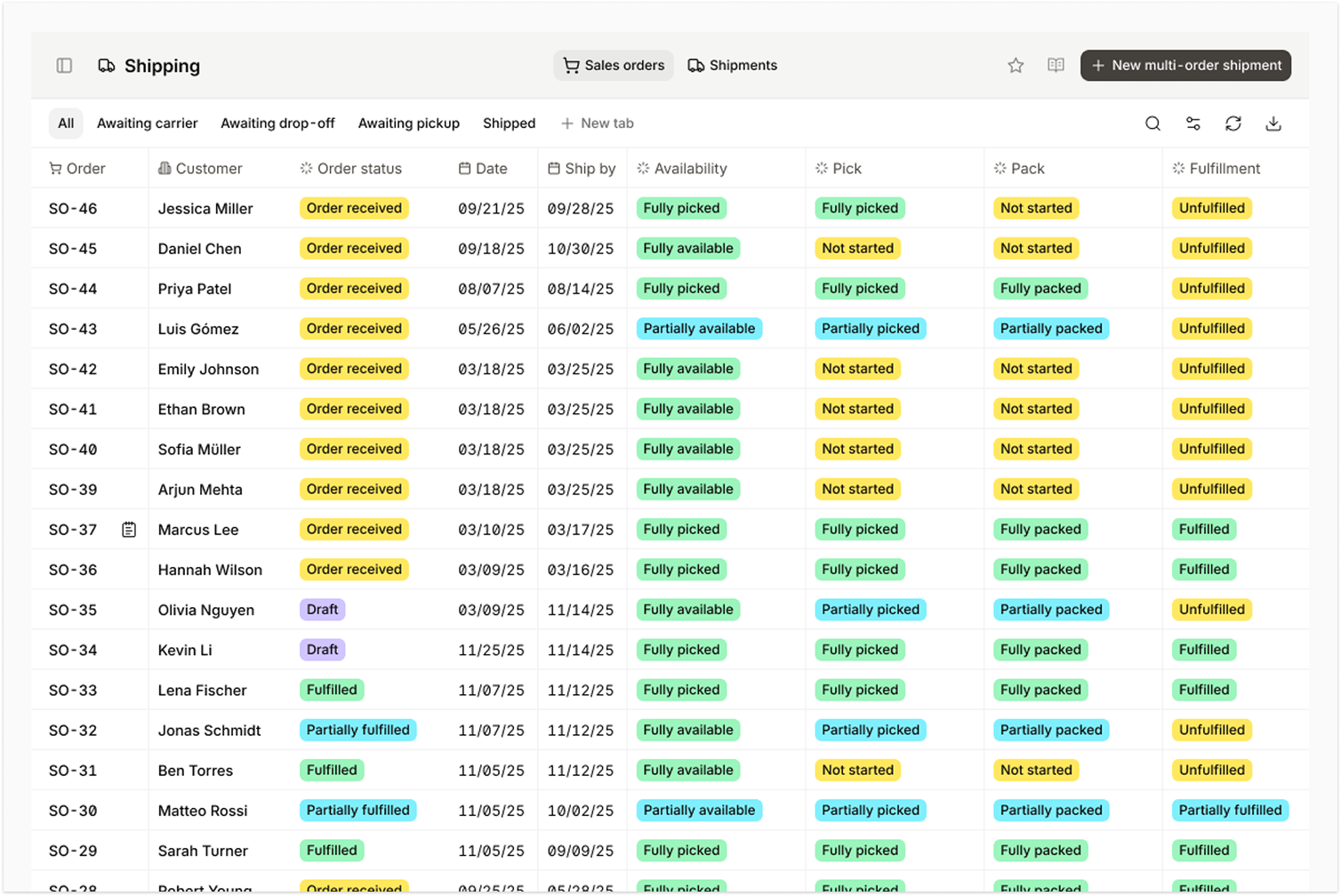
Digit helps B2B wholesale businesses operate faster and more accurately by replacing spreadsheet-based operations with a unified, real-time ERP built for growing manufacturers and distributors.
At the core is a single source of truth for inventory and production. Digit syncs purchasing, inventory, production planning, sales orders, and accounting in one cloud system, so teams aren’t reconciling conflicting numbers across disconnected tools. As materials are received, goods are produced, or orders ship, inventory updates instantly, giving wholesale teams the real-time visibility needed to avoid stockouts, prevent overselling, and keep lead times realistic.
Digit also supports the operational complexity common in wholesale.
B2B wholesale inventory management features like safety stock and reorder alerts help maintain balance across fast-moving SKUs, while MRP tools align materials with demand and capacity so purchasing and production stay coordinated. Warehouse workflows (picking, packing, and shipping with barcode scanning) reduce fulfillment errors and speed up throughput, which directly improves buyer satisfaction.
On the sales side, Digit streamlines the quote-to-order process and keeps teams aligned with pipeline management, sales order management, and customer-specific price lists. That means wholesalers can apply consistent pricing rules, reduce manual quoting, and move deals from negotiation to fulfillment with less administrative friction.
Digit also improves the buyer experience through its customer portal. Instead of constant email check-ins, wholesale customers can access real-time order status, shipment details, and account information through a secure portal. Customers can search, filter, and export order and shipment history to Excel, while the portal stays automatically synchronized with live data.
Finally, Digit integrates with common commerce and accounting tools and offers flexible API access, helping wholesalers centralize multi-channel operations without rebuilding their tech stack.