


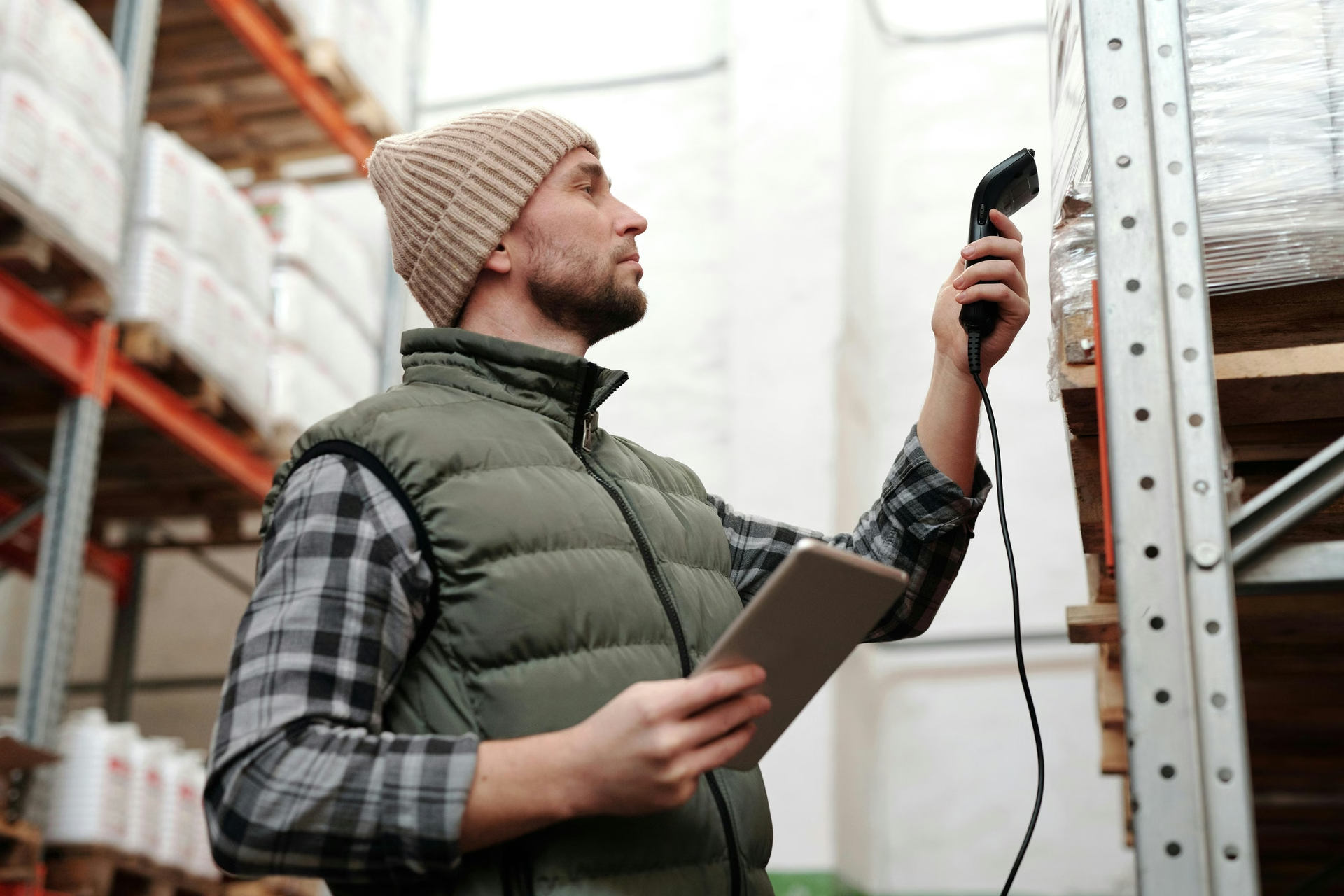
What is product traceability?
Product traceability is the process of tracking and documenting an item through its entire lifecycle, not just finished products, but materials and components too.
To successfully implement this process, you will likely need a tool to manage the volume of information to be recorded, as you will need to document where materials came from, how and when they were processed, and where the item moved next in the supply chain. Having this information saved will give you a detailed history of your product and allow you to trace an item regardless of where it is, and understand who worked on it and the production steps it went through.
6 Reasons Product Traceability is Important
.jpeg)
As you can likely gather from the name, it’s important because it enables you to track where something came from and where it ended up.
However, beyond the ability to track and trace a product, it also comes with a bunch of different benefits to reap once properly implemented:
- Improves efficiency
- Reduces costs
- Maintains profitability
- Performs quality control
- Mitigates risks
- Protects brand reputation
To expand on that final point, ensure your business's reputation by responding to issues promptly and avoiding a larger crisis. But even being able to prove to your customers that you are able to perform traceability will provide a significant boost to brand image.
Let’s explore the importance in a little more detail.
1. Regulatory Compliance and Risk Mitigation
For some businesses, product traceability is not optional.
Many industries are required to meet strict regulations that legally require companies to document product origins, manufacturing processes, and how products move throughout the entire supply chain.
Having product traceability implemented helps you demonstrate compliance with legislation designed to prevent:
- Unsafe
- Illegal
- Unethical practices
You may think this is for businesses that deal with something unusual (in terms of what a business might typically produce), like pharmaceutical companies synthesizing medicine.
However, regulations can affect businesses you might not otherwise expect.
Take, for example, apparel brands. A business must be able to prove that materials such as cotton were not sourced from prohibited regions linked to forced or child labour in order to comply with laws like:
- The Uyghur Forced Labor Prevention Act in the US
- Canada’s ban on forced labour
- The EU Forced Labour Ban
Failure to provide this proof can result in shipment detentions, fines, reputational damage, and significant financial losses.
2. Product Recalls and Quality Control
Probably the biggest thing that comes to mind when thinking about traceability is the ability to locate products in the worst-case scenario of a defective or contaminated item making it to market.
When safety is compromised, quality is shoddy, or a product isn’t compliant, product traceability will be pivotal in identifying affected products and getting them out of circulation. Without the ability to do this, you'll be forced into expensive recalls that affect entire product lines. But if you have proper tracking of batches, lots, or serial numbers, you can target specific items during a recall and easily contain them, protecting both consumers and your business.
Another useful function of product traceability is that it supports your ongoing quality control by providing granular insight into manufacturing processes. It enables you to trace defects back to specific materials, machines, processes, or time periods, making it easier to identify root causes and prevent repeat issues.
3. Protection Against Counterfeiting
Counterfeiting not only affects the apparel industry but also businesses producing electronic goods.
Counterfeiting has always been a costly problem across many industries, and it is only exacerbated by a global supply chain. According to some reports, luxury brands lose up to $30 billion yearly to fakes.
Setting yourself up with a product traceability system will help you combat counterfeiting by linking products to verifiable production data. Traceability techniques make it significantly harder for counterfeit products to enter legitimate supply chains, such as:
- Direct part marking
- Barcodes
- Serialisation
- Encrypted identifiers
When discrepancies appear in product traceability data, non-authentic products can be identified quickly and removed.
4. Consumer Trust and Brand Reputation
We touched on this a little earlier, but with more software available and the emergence of AI in manufacturing, which is making the process even easier, expect brands to prove that their products are authentic and align with the claims made on labels and in marketing materials.
Tying it back to luxury brands, this is important because some products are considered premium (and can be proved as such) due to their:
- Origin
- Materials
- Production methods
Mintel’s 2024 Brand Loyalty report indicates that trust plays a decisive role in consumer behavior.
More than four in five consumers say they would stop buying from a brand if their trust in it were broken. The report also finds that 88% of consumers place greater trust in certain brands over others, and that this trust is a key driver of their continued loyalty.
Without traceability in place to prove yourself during recalls or to prove the authenticity of your products, customers are likely to lose trust in you in droves.
5. Sustainability and Ethical Sourcing
Product traceability is an essential process for meeting sustainability and ESG (Environmental, Social, and Governance) commitments.
In the past, many businesses overstated or exaggerated their environmental and ethical credentials. For example, greenwashing (intentional or not) is when a company boosts its image as environmentally friendly without actually being so. According to a European Commission publication, a study found that 53% of sustainable claims were vague and 40% provided no evidence.
Due to this finding, the European Union introduced legislation to address this issue directly with the Corporate Sustainability Due Diligence Directive (CSDDD) that requires companies to accurately monitor, manage, and report on their environmental and social impacts across the supply chain.
So, long story short, with traceability implementation, you can now prove that the raw materials you sourced came from sustainably managed land or that your production processes met defined environmental standards.
And it doesn’t hurt to advertise this in your marketing.
6. Supply Chain Visibility and Operational Efficiency
Covid-19, war, geopolitical tensions, bridge collapses, and a trillion other things we have had to endure in these few short years have taught us that our supply chains are wide and complex, and extremely vulnerable to disruption.
And moving away from a macro standpoint, not only are supply chains vulnerable to interference, but globalization also means there’s a lot of opportunity for something to happen while an item is in transit.
Product traceability helps maintain supply chain integrity by ensuring your products have not been:
- Substituted
- Contaminated
- Altered (intentionally or not)
If you’re set up with a system that can give you an overview of your supply chain in real time, you will be able to find bottlenecks, inefficiencies, and recurring issues that would otherwise remain hidden, allowing you to improve:
- Production planning
- Waste reduction
- Disruption response
Now, that’s everything you need to know about product traceability in a nutshell, and now we can delve into the different systems you can use.
Understanding Different Types of Product Traceability Systems
Traceability systems come in all different shapes and sizes, and what might work for someone else might not necessarily work for you.
Traceability is performed in directions and at different levels of detail, all depending on where data is recorded and exactly how an item moves through a supply chain. Understanding the different methods of tracking is going to help you determine the best traceability approach that matches your:
- Operations
- Regulatory requirements
- Risk-management needs
Upstream (Backward) Traceability
Upstream traceability, sometimes also referred to as backward traceability, focuses on tracking an item all the way back to its supplier.
Think of it like a river: you start at the point where the river opens into the channel and follow it all the way to its source, like a mountain top, spring, or lake. Upstream product traceability in manufacturing provides a historical record of where materials came from, which suppliers were involved, and which processes were used in production. To gather these insights, the upstream method typically requires ways of tracking:
- Supplier identity
- Batch or lot numbers
- Quantities
- Arrival dates
- Expiry dates
- Quality or hygiene checks performed
True upstream traceability starts before materials even arrive at your facility. When a supplier ships a batch of ingredients or components, that batch needs to be received, documented, and linked to a purchase order. This creates the first entry in what becomes the batch's genealogy.
From there, every time that batch moves into storage, into production, into a finished good, and out the door, the chain grows. The result is a complete, auditable record that connects a finished shipment all the way back to the original supplier lot. To make this work, supplier onboarding matters as much as the technology itself.
Suppliers need to provide consistent documentation at the point of delivery, including certificates of analysis (COAs), safety data sheets (SDSs), and any relevant quality certifications. Without this information arriving with the goods, traceability gaps open up at the very start of your supply chain, and those gaps are the hardest ones to close after the fact.
Upstream traceability will help you identify exactly where problems occur in your supply chain, so you can take corrective action at the source rather than perform damage control further downstream, such as massive, costly product recalls.
Downstream (Forward) Traceability
Now we move in the other direction with downstream traceability (or forward traceability), starting at the river's origin and working our way to the sea.
With this method, we’re mostly concerned with focusing on the distribution aspect of selling products, such as monitoring:
- Warehousing
- Transportation
- Delivery routes
- Shipping conditions
- Delivery dates
Identifying and tracking products is done using batch numbers, serial numbers, barcodes, or RFID tags, making it much easier to follow goods through distribution channels — especially useful if you’re using omnichannel management in your sales fulfillment flows.
Internal Traceability
The least intensive method of tracking products can be achieved with the right add-ons and barcode fonts, even in spreadsheets.
Internal traceability focuses on tracking products and materials within a company’s own facilities by monitoring how raw materials are received, stored, processed, used, and manufactured into a finished good.
This won’t be very helpful if you’re in a heavily regulated industry. But, if you want to improve your inventory control and management, then internal traceability might be enough as it will give you what you need to improve carrying costs and implement better performance metrics for your team.
External Traceability
But what about businesses that outsource their manufacturing processes? This is where external traceability comes in.
Just because someone else built it doesn’t mean that you’re not responsible for the final outcome, and you will need a system to help you track products that are with your external partners, such as:
- Manufacturers
- Carriers
- Distributors
- Logistics providers
Setting up this type of traceability method helps you ensure continuity of information across all your organisational boundaries. Should an issue arise outside your company's control, external traceability will provide the data you need to respond quickly and coordinate with partners to resolve it.
End-to-End Traceability
Last but not least, we have end-to-end traceability, and, to make a long story short, it combines all of the above into a single, continuous view of the supply chain, providing you with full visibility from raw material sourcing through production, distribution, and final delivery.
With end-to-end traceability, every single process, supplier, and handoff is documented, allowing you to see and analyse performance across the entire product lifecycle. It doesn’t get any more comprehensive than end-to-end traceability, which is the bedrock of advanced supply chain visibility, accountability, and optimization.
Nowadays, most tools with traceability give you an end-to-end view of your product movements, and it would be extremely tedious and difficult without them.
What Supplier-Side Traceability Captures
.jpeg)
At its core, supplier traceability connects your purchase orders and goods receipts to a structured set of supplier-provided data. For each incoming batch or lot, you should be capturing:
- Supplier identity and certification status, including verified credentials such as ISO certifications, ethical sourcing audits, or material compliance declarations (e.g., RoHS, REACH, or organic certification). These should be document-linked, not just noted in a field.
- The supplier’s own batch and lot numbers at receipt
- Maintaining the supplier's reference allows you to cross-reference their records during an investigation or recall.
- Material genealogy and sub-tier suppliers are a must for high-risk industries. You need tracing through tiers, not just one level up.
- Inspection and quality data at receipt: This includes Certificates of Analysis (COAs), Safety Data Sheets (SDSs), and incoming quality control (IQC) results should be attached directly to the batch record.
- Shelf life and storage conditions, particularly for food, pharmaceutical, and chemical inputs, the date of manufacture, expiry date, and required storage conditions (temperature, humidity) must be recorded at receipt and monitored throughout storage.
Why the Supplier Link Is the Weakest Point
Supply chains are only as traceable as their least documented handoff. In practice, the transition from supplier to your facility, the goods receipt event, is where batch genealogy most commonly breaks down. Common failure modes include:
- Receiving teams logging a new internal lot number without preserving the supplier's batch reference
- COAs filed as paper documents or email attachments, detached from the inventory record
- Supplier audit and certification data stored in a separate procurement system with no live link to production batches
- Sub-tier supplier information captured once at onboarding but never updated as supply chains shift becomes a liability in regulated industries.
Each of these gaps creates a situation where you hold goods you cannot fully account for. Supplier-side traceability adds value when incoming batch records are carried forward into production. When a batch of raw material is consumed in a production run, that supplier batch reference that has its COA, expiry date, and certification data, should flow through to the finished goods record.
This creates a full genealogy: from the supplier's batch number, through your goods receipt, into your work-in-progress, and out to the serialized or lotted finished product that ships to your customer.
Industry-Specific Product Traceability Requirements

As you can tell, product traceability serves an important function, not only to help you optimize your inventory management, but to ensure you’re protected both legally and image-wise should something run amok.
The requirements for traceability vary significantly from industry to industry, driven by differences in:
- Risk
- Product complexity
- Regulatory oversight
- Potential impact on public safety
If you’re looking to set up product traceability in your business, understanding these industry-specific requirements is essential for selecting the best system for your particular use case.
Aerospace and Defense
Few industries demand more rigorous product traceability than aerospace and defense because if a single component fails at 30,000 feet or on the battlefield, it would be an understatement to say there would be a problem.
Manufacturers in this industry need to trace almost every piece used in a build, all the way back to its supplier (not just components, but also the nuts and bolts). They need evidence proving authentication, including how and when a component was built.
And they need to be able to provide a genealogy of the final product — essentially a family tree detailing how everything relates to each other.
Regulators, safety investigators, and other authorities can demand access to these records at any point, and when something goes wrong, or even when something might go wrong, complete traceability is going to help you keep your business from descending into chaos.
Pharmaceuticals and Medical Devices
The pharmaceutical and medical industries are heavily focused on patient safety and, horrifyingly, on counterfeit prevention.
To ensure patient safety, regulators require that products be identifiable and traceable throughout production, distribution, and dispensing, and to do this, manufacturers need to maintain accurate records linking products to:
- Batch numbers
- Expiry dates
- Production sites
- Distribution channels
- Unique Device Identification (UDI), in the case of medical devices
Food and Beverage
The one industry that probably pops to all our minds when we think about product traceability is food and beverage.
Because businesses here handle perishable inventory and sell goods for human consumption, regulators commonly require businesses to track ingredients and finished products through each stage of production and distribution. This means a company must maintain accurate records of sourcing, processing, and distribution, which are essential for managing risks of contamination, undeclared allergens, and food safety incidents.
Electronics and Automotive
Electronics and automotive manufacturers face regulatory requirements driven by:
- Safety
- Environmental regulations
- Counterfeit prevention
Products and components must be traceable to verify material composition, supplier compliance, and ensure that no regulations are being breached, such as hazardous substance restrictions and recycling obligations. Traceability implementation will also help support large-scale recalls by enabling manufacturers to efficiently identify affected components and vehicles, limiting operational and financial impact should an issue arise.
Apparel and Textiles
We won’t delve into this too much as we covered it earlier in the article, but to reiterate, for the apparel and textiles industry, traceability requirements increasingly focus on:
- Ethical sourcing
- Labour practices
- Environmental impact
Regulatory and market pressures are pushing companies to demonstrate compliance with labour standards and sustainability commitments, making product traceability a key tool for accountability across global supply chains.
Choosing the Right Product Traceability Technology

So, it probably goes without saying that, in one way or another, product traceability is going to be pretty important for your business, either operationally or legally.
So, as already pointed out, businesses have different requirements, and systems have different ways of getting the job done. You’re going to need to find out which approach fits your data needs, your operations, and where you want to be in the long run. So, to help you make that decision, here are 5 things to consider before picking a system.
5 Key Factors to Consider
Before jumping into the deep end and getting lost among the many technologies available to you, you should whip out a pen and paper and define your requirements:
1. Data needs and level of detail: One business may only require basic identification for internal traceability, while you may need a tool that comes with all the bells and whistles, such as batch numbers, serial number tracking, timestamps, or environmental data. This will be your first step in deciding if you need inventory management or an end-to-end traceability software.
2. Your operations: What is going on within your shop floor, and does the tool need to be aware of it? Do you have a continuous production run or batch? Do you need to monitor factors like lighting, dust, moisture, and heat during your production runs? If you just need to track items and batches, lots of cloud-based inventory management solutions can do this, but if you need to monitor a bunch of other stuff, then you might need to consider hardware also.
3. Cost and total cost of ownership: Which leads nicely to the next point, as hardware and software subscription costs are only one part of the equation. Software licensing, maintenance, training, and ongoing operational effort all add up. Lower-cost technologies may be sufficient for some workflows, while higher upfront investment can be justified where risk or regulatory exposure is significant.
4. System integration: Nowadays, there aren’t many businesses that rely on one tool. And if they are, they’re running the risk of being left behind by the competition. Whatever product traceability tech you adopt, choose one that integrates with existing systems such as ERP, MES, and quality management platforms to avoid data silos and manual workarounds.
5. Scalability and future-proofing: To keep with the river analogy used earlier, even the course of a river will change over time due to several factors. Tech and trends are the same. When selecting a tool or platform, make sure it can scale across products, sites, and suppliers to help avoid costly replacements as regulatory or business needs evolve.
Getting Started with a Product Traceability Solution like Digit
If you’re pressed for time and would rather jump straight into the piloting phase of choosing a new product traceability system, you can always try Digit.
Digit gives you a searchable and auditable trail by connecting:
- Supplier receipts
- Inventory movements
- Production runs
- Shipments
Batch and lot tracking updates automatically, helping you and your team pinpoint where materials came from, how they were used, and where finished goods were packaged and shipped, enabling you to perform faster and cheaper recalls and investigations.
For highly regulated businesses selling or managing high-value items, serialized inventory links each unit to the materials, quantities, and work performed, giving you greater accountability should a problem arise in your supply chain. And as for documentation tracking, Digit also supports document uploads, so you can attach COAs, SDSs, certifications, and QC checks to batches, with shelf-life monitoring and audit trails.
Want to see for yourself? Book a demo today and test it in your production flow. When you’re ready to ask questions or need help, feel free to reach out.