


What Is a Lot Number?
A lot number is a unique identifier you use to track essential information on a group of products — determining this group of products is usually done by:
- Manufacturing date
- Expiration date
- Purchase order date
- Location by production or processing date
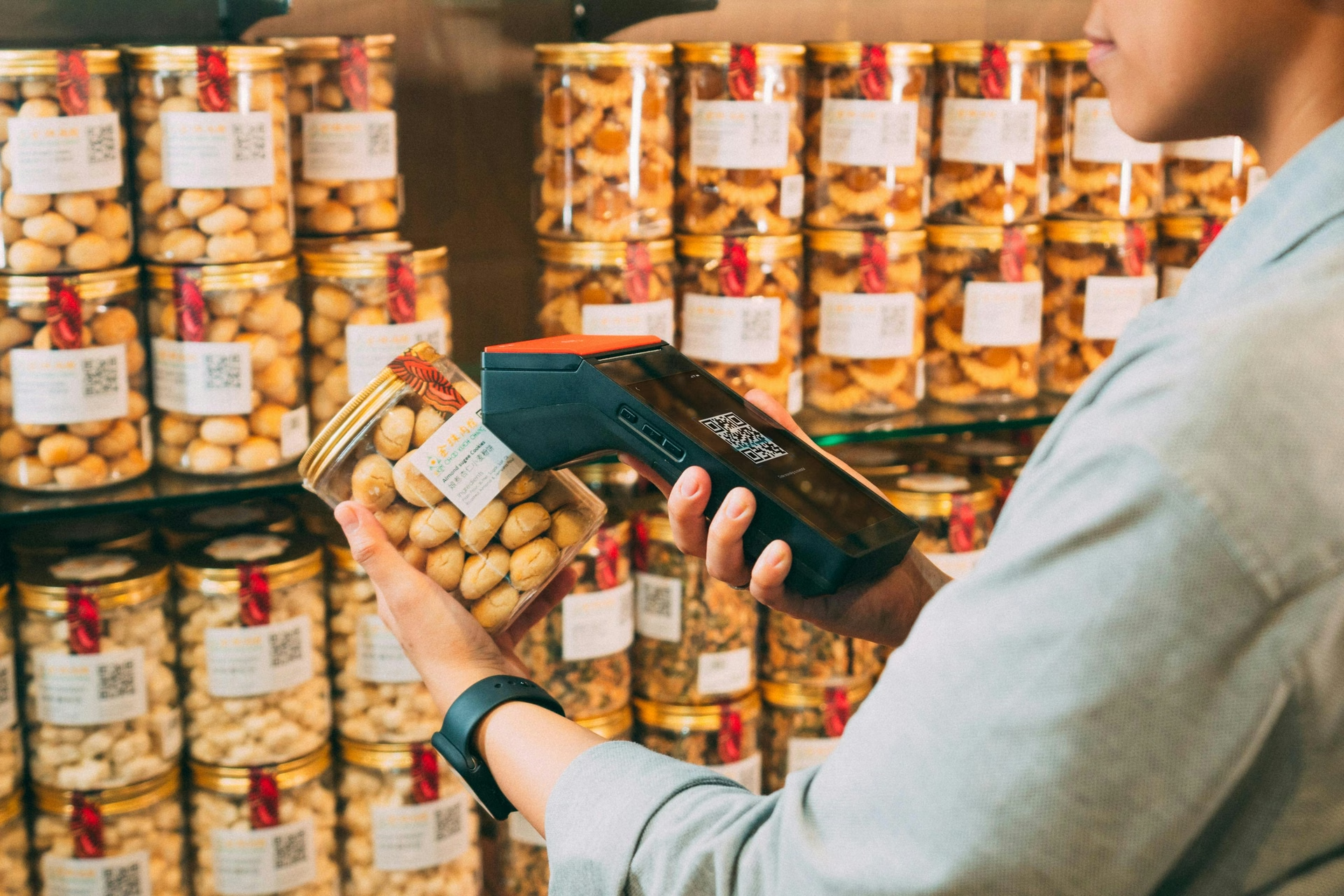
These codes are created internally but can appear on packaging as a printed code, a series of letters and numbers, or even a barcode for automated inventory tracking.
Even though there are differences (which we will explore later), they are often interchangeably referred to as batch numbers, lot codes, or production codes.
The reason lot numbers are important for manufacturers is because it helps them track a specific group of inventory amongst an entire warehouse full of the same product. For example, SKUs track product types, UPCs give manufacturers and vendors an identifier that both can use for tracking, and serial number tracking helps you identify individual items. Then come your lot numbers, which help you capture the time and location an item was received into inventory in a single code — important for tracking perishable goods and for businesses operating in a highly regulated industry.
Having the time and location recorded enables industries like food and beverage, pharmaceuticals, cosmetics, electronics, and more to implement end-to-end traceability.
If a defective product makes it into the marketplace, or a safety issue is discovered during quality checks, all the items sharing that same lot number can be quickly identified, located, and removed from inventory or recalled, without causing any further problems.
How to Read and Decode a Lot Number
.jpeg)
First things first, where do you even print the lot number?
Usually, it’s grouped and printed together with expiration or best-by dates on the outer packaging. But it really depends on the product type:
- On canned goods, the code is usually stamped on the bottom of the tin can
- For pharmaceuticals and cosmetic products, it’s printed directly onto the packaging
- For some consumer goods, it might be printed on a seal or a small white label
There's no single rule that defines how the number should be formatted or created. But, they usually follow some sort of pattern of combination to form the number, taking info from the:
- Manufacturer code
- Production date
- Batch number
For example, let's imagine there's a company called Manufacturers United, they might print a lot number on some sub-assemblies that looks like this:
MU0311-1234
Let’s break this down:
- MU — Manufacturers United
- 0311 — The date of production
- 1234 — Batch number, in this made-up scenario, it’s the 1234th batch produced by the company.
A code like ABC0822-5678, for example, might use the first three characters to identify the manufacturer, the next four to encode the production date (August 2022), and the final four to designate the batch.
Lot Number vs. Serial Number vs. Batch Number: What's the Difference?

We’ve already touched on this a little, but these terms are used interchangeably, so it can be a little difficult to understand what the difference is (or even if there is a difference).
Here’s a quick breakdown to make it all a little clearer:
Lot Numbers
A collection of letters and numbers to create a unique identification code tracking a specific batch of products produced, purchased, or processed together under the same conditions.
Batch Numbers
Work almost in the same way as lot numbers. But the main difference between these two is that a batch number is used specifically for tracking a group of products manufactured under the same conditions.
Serial Numbers
Now these are entirely different and used to track one single unit — this single unit may also come from a batch or not.
And it's not just single units that get serial numbers, so too do components and subassemblies. You can think of it like a social security number of things, as opposed to people. While lot numbers give you an overview of inventory where it’s critical to identify items within a batch, serial numbers give you a granular, unit-level view, helping you manage high-value or warranty-bound products like electronics, machinery, and vehicles.
As already touched upon, you may often use both batch and serial numbers. Like in pharmaceutical manufacturing, you may want to track a batch of tablets, while also using serial numbers to locate an exact box.
Why Lot Numbers Matter: The Business Cost of Getting It Wrong

So, it becomes apparent pretty quickly just how important it is to use lot numbers within your manufacturing processes — especially if you’re a business that needs to have traceability capabilities.
But if you’re still not sure if adopting them is important for you or not, maybe the following information will be enough to shake you to your core and realize that not implementing these can have serious repercussions.
The dreaded recall.
A recall is one of the most financially damaging processes a business can go through.
According to a survey published by the Food Marketing Institute and the Grocery Manufacturers Association, the estimated expenses for a recall are around $10 million per event, as businesses need to cover (and it doesn’t factor in lawsuits, lost contracts, or long-term brand damage):
- Retrieval
- Disposal
- Notifications
- And any other related costs
If you’re a mid-market food company operating with $150 million in revenue, that $10 million will be the equivalent of your entire annual net profit.
Surprisingly, even with advancements in AI and other tech, voluntary recalls increased from 313 in 2023 to 333 in 2024, according to the U.S. Consumer Product Safety Commission. It might only be an increase of 20 recalls, but this comes with extra costs and wasted time due to paperwork, refunds, and strain on customer service across the supply chain. Even distributors and retailers end up feeling the pinch even when their own products aren't directly at fault.
It doesn’t have to be a manufacturing issue that causes recalls. For example, labeling errors alone led to 192 FDA recalls in 2024, resulting in an estimated $1.92 billion in direct industry losses that year.
In some respects, there’s almost an inevitability to a recall, since it can be triggered by a manufacturing mishap or a typo on a package. The trick is to have effective lot tracking in place to ensure efficient recall management.
Take the case of Georgia-based Alma Pak International. In June 2025, they voluntarily recalled organic blueberries after testing revealed Listeria monocytogenes contamination. Thankfully, their lot code practices were on point — and by establishing a precise system, they were able to identify the two affected batches of blueberries and initiate a recall… they only needed to perform a recall from a single customer in North Carolina.
Without lot tracking codes, they would have had to trigger a larger recall of blueberries that would have spanned multiple states, dramatically increased costs, and caused reputational damage to their brand.
This warning about not implementing lot tracking shouldn’t be limited to manufacturers; distributors should heed it too.
Without proper tracking in place, you will risk:
- Litigation
- Product write-offs
- Profit margin loss
How Manufacturing Software Transforms Lot Tracking
.png)
Manual lot tracking (spreadsheets, paper logs, handwritten batch records) creates gaps that only become visible at the worst possible moment.
When a recall is triggered or an auditor arrives, the time spent reconstructing batch histories from disconnected records compounds risk. Manufacturing ERP software addresses this by making lot tracking continuous, automatic, and searchable rather than something that has to be assembled after the fact.
The most immediate difference is at the point of receiving.
When raw materials arrive, software logs the:
- Supplier details
- Delivery date
- Lot number
- Associated certifications
- Test results
As those materials move into production, the system automatically links them to the manufacturing orders they supply, recording which lots were used, in what quantities, and under what conditions. Each subsequent stage adds to a connected data trail without requiring manual re-entry at each handoff.
This creates what is sometimes called forward and backward traceability. This is the ability to look upstream from a finished product to identify every raw material lot that went into it, or to look downstream from a raw material lot to find every finished product it contributed to. In a manual system, building that picture during a crisis can take days. In a software system, it typically takes seconds.
Audit readiness is another area where software changes the operational picture significantly.
Certificates of analysis, safety data sheets, quality check results, and expiration records can all be attached directly to a batch record and retrieved instantly. Rather than pulling physical binders or searching email chains before an inspection, manufacturers have a complete, timestamped audit trail that travels with every lot through the system.
Real-time inventory visibility rounds out the picture.
Software tracks lot movements across multiple warehouse locations and bin levels simultaneously, applying inventory rotation rules like FIFO and FEFO automatically rather than relying on warehouse staff to enforce them manually. Reorder alerts tied to specific lot quantities, cost visibility at the batch level, and barcode or QR code scanning for faster, more accurate receiving and picking all reduce the friction that makes manual lot tracking error-prone at scale.
Are you looking to optimize your lot number tracking? Digit is a manufacturing software that enables you to implement end-to-end traceability across your entire supply chain. Try chatting with Digit's free AI demo and see how easy it is to set up lot tracking within your business.

%20(2).jpg)