%201.svg)


What Is WIP Inventory?
.jpg)
WIP (short for work-in-progress) inventory refers to the inventory that has entered production, but isn’t yet ready to be sold — basically an in-between stage between a raw material and a finished product.
An item in WIP has resources already committed and being consumed as it's turned into a final product that can be sold. Imagine making a pizza from scratch. The dough has been rolled out, the sauce has been spread all over it, and the cheese has been sprinkled onto it from above in a Salt Bae manner. However, for this particular pizza, it's not a margherita you're making, so you’re waiting on someone at another station who is slicing salami for pizza toppings.
This uncooked, not-quite-ready-to-be-cooked pizza is sitting in WIP inventory because it’s no longer raw material (since the dough can’t be converted back into flour and the sauce can’t be poured back into the bottle), but it’s not a pizza ready for the customer yet either.
And let’s imagine pizzas didn’t take half an hour to make, but days.
It’s important that this unfinished pizza is tracked as WIP inventory because it’s a component of the inventory asset account on the balance sheet. The pizza, even though unfinished, has a value, as things have been committed to its production, and WIP tracks that value by looking at the accumulated costs of:
- Raw materials
- Direct labor
- Manufacturing overhead
The salami won't be tracked in these costs, nor will the pizzas that were already cooked and held on a hot plate, ready to be sold. But once the salami is added and production continues, these accumulated costs move from the WIP account to finished goods and, once the item is sold, to cost of sales.
So, WIP serves an important accounting function, but it can also be used for analyzing how well a production line is running.
One pizza waiting for toppings, although not great, is fine. But, if more and more pizzas are being held in WIP waiting for toppings, this indicates a problem that is occurring on the line somewhere, which could be from:
- Bottlenecks
- Interruptions
- Poor planning between stages
Note: High WIP inventory levels can be a part of a make-to-stock strategy. But if you’re not actively doing this, high or low levels can indicate a problem in your supply chain and should be used as a KPI to analyze how well your business is doing.
Work in Process vs. Work in Progress: What's the Difference?

Now, let’s make everything even more confusing with the introduction of a different WIP abbreviation — Work in Process.
Even though the terms are used interchangeably, each represents a distinct type of unfinished work and carries its own accounting treatment.
Work in Process
Work in process inventory refers to the items that have entered the manufacturing stage and are moving toward becoming a final product, all of which happens within a pretty short time frame.
As work in process has tangible goods tied to the production line, on the balance sheet, it is recorded as a current asset. To make that definition easier to understand, it simply refers to products built from subassemblies, such as a set of partially assembled bicycles waiting for wheels and chains. Work in process is the preferred terminology for manufacturers or supply chain managers who need to account for unfinished inventory and operate businesses such as:
- Food producers
- Textile mills
- Technology manufacturers
Work in Progress
Work in progress refers to longer-term undertakings that can span months or years. This includes things like:
- Construction projects
- Software development
- Consulting engagements
Let’s imagine what it takes to build a house. There needs to be landscaping done, a foundation placed down, walls built, electrical work completed, windows installed, and the list goes on. Because the project to build one house spans different fiscal periods, the WIP inventory is tied to job contracts. It's usually still reported as a current asset — even multi-year projects count as 'current' if they fall within the normal course of business. The 'noncurrent' version applies only when a company builds something for its own permanent use, such as constructing its own office building rather than one it plans to sell.
WIP vs. WIP: Which should I use? As already mentioned, they're used interchangeably, and even though your accountant might huff and puff, most manufacturers refer to inventory being consumed to make something as work in progress… whether it’s a pizza or a house being built.
The Three Cost Components of WIP Inventory
.jpg)
To calculate the value of your WIP inventory, you’re going to need information on three cost categories that are going to represent the capital which is currently tied to your shop floor.
These three cost components of WIP inventory are:
Raw Materials
The baseline costs of the raw materials that have been committed to production and have been moved to the shop floor.
For understanding your WIP costs, you won’t be looking at just the purchase price — you will also need to factor in any additional costs that are associated with them, such as:
- Freight
- Shipping
- Customs duties
Whatever costs were incurred to obtain your raw materials (which have been moved into production) need to be included in the cost calculations.
Direct Labor
To convert raw materials into a final product, you need labor, and labor comes with costs such as wages, salaries, and company benefits.
Whether your workforce is made up of machine operators or assembly staff, if someone directly contributed to the production of a finished good (using the WIP inventory), then their costs need to be factored in. But again, only if their efforts can be directly attributed to making a product, because here you will be excluding any support roles like supervisors or maintenance staff (as their costs will be factored into the following category).
Manufacturing Overhead
Finally, we have manufacturing overhead, which captures any indirect costs that are associated with keeping your factory and production lines running, such as:
- Factory rent
- Utilities
- Equipment maintenance
- Machinery depreciation
- Production supervisor salaries
As the list above can’t exactly be attributed to the production of a single thing, to calculate these costs as WIP inventory, you’ll need to use standard costing methods rather than a direct per-unit calculation.
With raw material, direct labor, and manufacturing overhead costs to hand, you now have everything you need to calculate your WIP inventory and update your balance sheet. But, how exactly do you perform a WIP inventory calculation?
How to Calculate WIP Inventory
.jpg)
There are a bunch of different things needed for your WIP inventory formulas.
Here is how ending WIP inventory is calculated using a standard accounting formula:
Ending WIP = Beginning WIP + Manufacturing Costs Added − Cost of Goods Manufactured (COGM)
You can use this formula to calculate how much capital is tied up on your shop floor at the end of an accounting period. To find out your Beginning WIP, Manufacturing Costs Added, and Cost of Goods Manufactured (COGM), here's what you'll need:
- Beginning WIP — This is the ending WIP balance carried forward from the previous accounting period.
- Manufacturing Costs Added — This is the total of raw materials, direct labor, and manufacturing overhead that was accumulated during the current accounting period.
- Cost of Goods Manufactured (COGM) — This is the total cost of all goods completed during the period and moved into finished goods inventory.
A lot of information, right? To make it easier to understand, here’s a WIP inventory calculation example.
A WIP Inventory Formula Example in Action
Let’s say you’re a manufacturer who needs to find out what the month-end WIP inventory is, since a bunch of orders have rolled into a different accounting period. Here are the financials you have to hand:
- Beginning WIP — $8,000
- Materials Used — $2,000
- Direct Labor — $3,000
- Manufacturing Overhead — $1,000
- COGM — $9,000
The first thing you will need to do is calculate the total for your manufacturing costs for the period:
Manufacturing Costs = $2,000 (Materials Used) + $3,000 (Direct Labor) + $1,000 (Manufacturing Overhead) = $6,000
Then apply the WIP inventory formula:
Ending WIP = $8,000 (Beginning WIP) + $6,000 (Manufacturing Costs) − $9,000 (COGM) = $5,000
That final figure you’ve found, the $5,000, represents the current value of your WIP inventory that is still in production.
How to Reduce WIP Inventory Without Disrupting Production

Reducing WIP without disrupting production isn't about slowing the factory down — it's about exposing and fixing the root causes of downtime and delay rather than masking them with a pile of buffer inventory.
The relationship between WIP and performance follows from Little's Law, which links the arrival rate of new work, the amount of WIP in the system, and throughput: on average, WIP equals the arrival rate multiplied by the lead time. In practice, this means that limiting how much work enters a system doesn't just shrink an inventory number — it forces problems in the process to surface.
If restricting new work causes a backup somewhere, that backup was always there; low WIP just makes it visible instead of letting it hide.
Implement Strict WIP Limits
Move from forecast-based release of raw materials to a pull-based system such as Kanban, where new work is only authorized once existing work clears — a common version is the "2-for-1" rule, releasing one new work order for every two completed.
Restricting inflow this way immediately surfaces bottlenecks that excess WIP had been quietly absorbing, giving teams a clear target to fix rather than a vague sense that things feel slow.
Attack "Fear Buffers" with Machine Reliability
Operators often build up WIP between machines out of fear — fear that an upstream machine will break down and starve them, or that their own machine will fail and stall the downstream process.
Unplanned downtime is one of the biggest hidden drivers of excess WIP, and the fix is to remove the uncertainty that makes the buffer feel necessary. Increasing the mean time between failures through condition-based maintenance on the machines feeding into WIP piles is the most direct route. Giving operators visibility into real-time uptime for upstream equipment also helps — when they can see a machine is running reliably, they stop hoarding material against a failure that isn't likely to happen. Maintenance resources are best targeted specifically at the assets causing recurring starve/block events, rather than spread evenly across the floor.
Shrink Batch Sizes
Large batches guarantee high WIP by definition — running 1,000 units through step one before moving any of them to step two means 1,000 units of WIP sitting idle, even if the line itself is efficient.
Factories often default to large batches to avoid frequent changeovers, but that logic optimizes a single machine at the expense of the system as a whole. Shortening changeover times through SMED (Single-Minute Exchange of Die) makes smaller batches economically viable — if a changeover drops from two hours to ten minutes, running batches of 100 instead of 1,000 stops being a productivity hit. Digital setup guides can standardize and speed up changeovers further, and grouping similar products into planned production campaigns helps minimize major changeovers while still allowing smaller, more frequent ones.
Balance the Production Line
WIP accumulates wherever flow stops.
If one process runs at 100 units per minute and the next can only handle 80, that gap generates 20 units of WIP every single minute, permanently, until something changes. The fix isn't to speed up the faster station — it's to balance the line, which sometimes means deliberately throttling the faster process to match the slower one, preventing the pile from growing while saving on unnecessary energy and material use. Setting a hard maximum buffer size between stations, enforced automatically with sensors that stop the upstream process once the buffer is full, keeps this balance in place without relying on manual oversight.
Eliminate Rework Loops
Rework is effectively WIP that should never have existed in the first place — a product that should have shipped but is stuck in a cycle of repair and reinspection.
These piles clog aisles, disrupt scheduling, and require extra handling and tracking on top of the original production cost. Tracking quality at the source (first-pass yield) rather than catching problems downstream helps prevent rework from accumulating from the start, and linking quality data to maintenance systems can catch machine drift before it produces a run of defective parts. Enforcing a strict disposition rule (fix it or scrap it within 24 hours) keeps rework from quietly becoming long-term WIP.
Digitize WIP Tracking
In many plants, WIP is invisible to the planning system — the ERP tracks raw materials and finished goods, but the middle of the process is a blind spot. That blind spot leads to ordering more raw material than actually needed, which only adds to the pile. Real-time production tracking replaces retrospective paper tracking with a live view that planners can act on immediately, rather than after the fact, with:
- Operators logging movement at each step
- Barcode or QR scanning attached to WIP bins
- A visual dashboard showing where inventory is bubbling up across the floor
And that’s everything you need to know about WIP manufacturing and inventory, and how to calculate the value of the inventory on your shop floor. It’s cool, and all that you have are the formulas to make these calculations, but that is time-consuming, which will steal away resources from your business that could otherwise be better spent elsewhere.
That’s why many manufacturers turn to inventory management solutions like Digit.
Managing WIP Inventory with Digit
.jpg)
Tracking WIP manually through spreadsheets or paper travelers is exactly the kind of blind spot that lets excess inventory build up unnoticed.
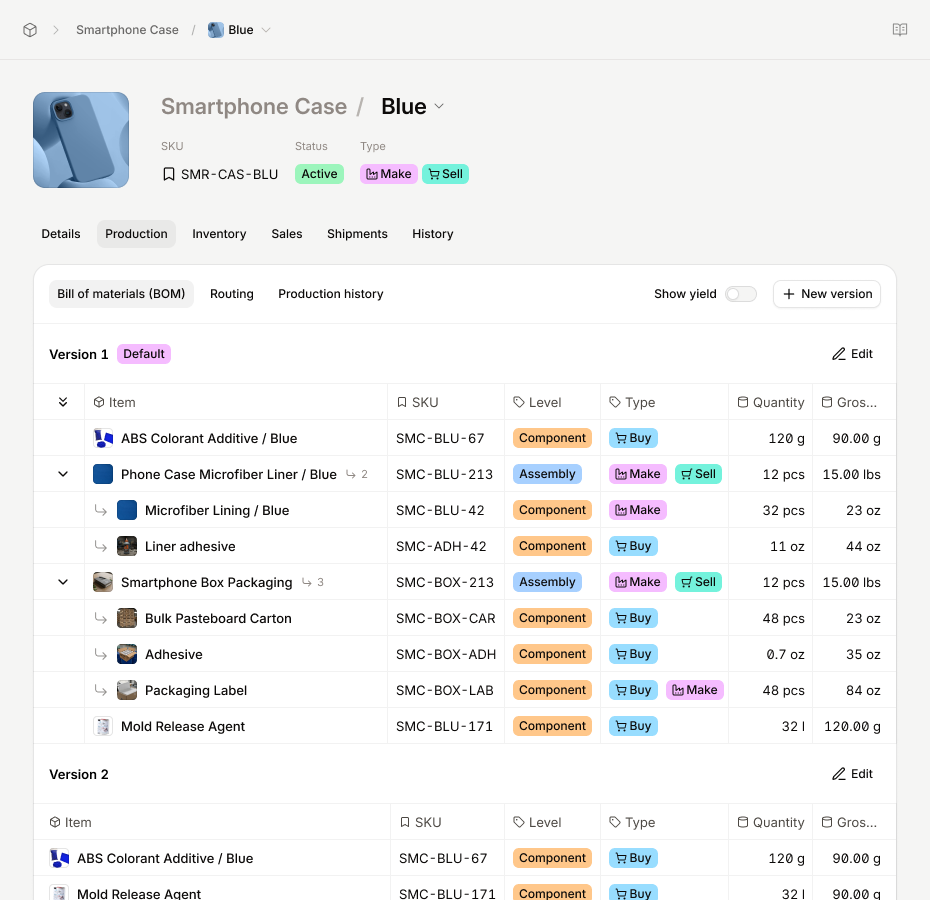
Digit is an MRP software built to close that gap, giving manufacturers real-time visibility into raw materials, WIP, and finished goods within a single connected system rather than three disconnected records.
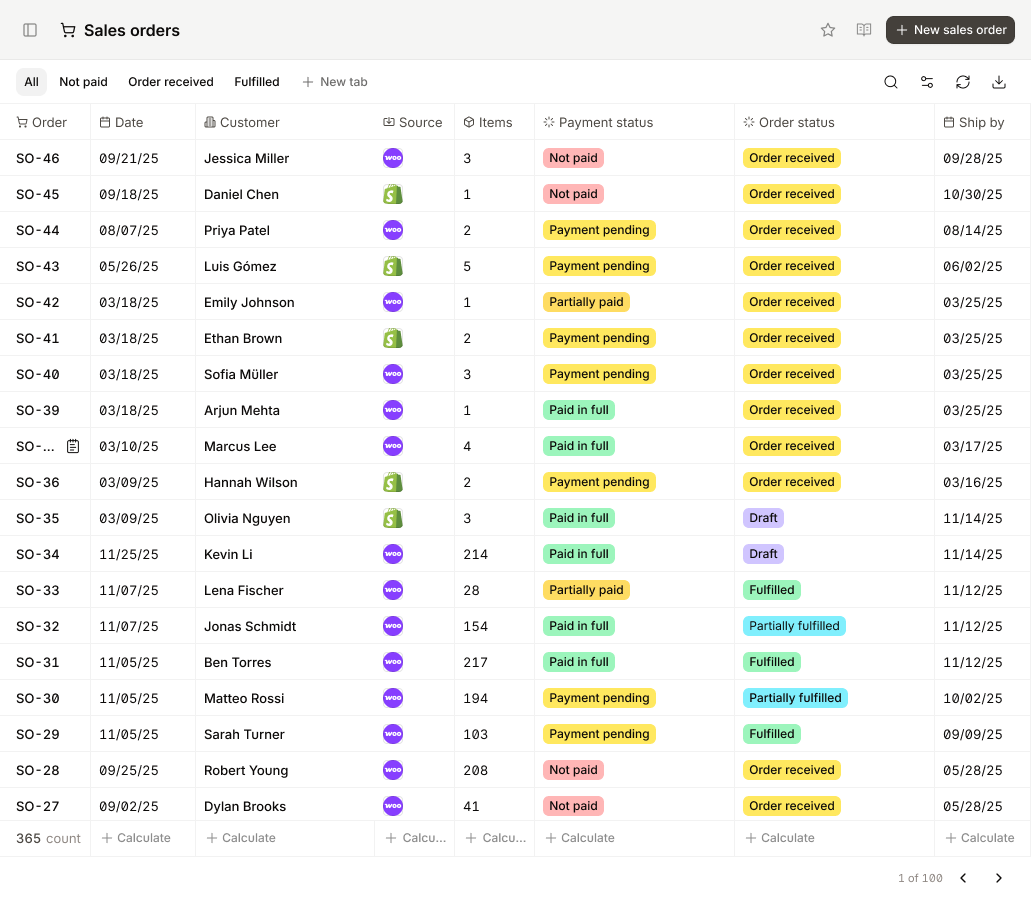
Stock levels are updated automatically whenever items are bought, sold, produced, or consumed, so a WIP figure reflects what's actually on the floor rather than a count from last week's manual walkthrough. Teams can view nested pallets and containers, and scan, adjust, or reduce item levels directly from a pallet or container, and set safety stock and reorder points to catch shortages before they stall production.
On the purchasing side, inventory, production, and sales data stay synchronized so that every sales order and work order is fulfillable against real stock, not a forecast. Orders can be received in full or in part, with stock and costs updating instantly. Purchase order lines connect directly to specific products and suppliers, and unexpected receipts automatically generate the appropriate purchase order rather than requiring manual reconciliation after the fact.
For manufacturers running multiple sites, Digit tracks bin-level locations across every warehouse and storage location, with automatic updates and full traceability whenever inventory transfers between them. Serial and lot tracking extends that same visibility down to the individual unit, which matters directly for WIP — knowing exactly where a batch is and what's been done to it is what makes bottleneck identification and rework tracking possible in the first place, rather than guesswork.
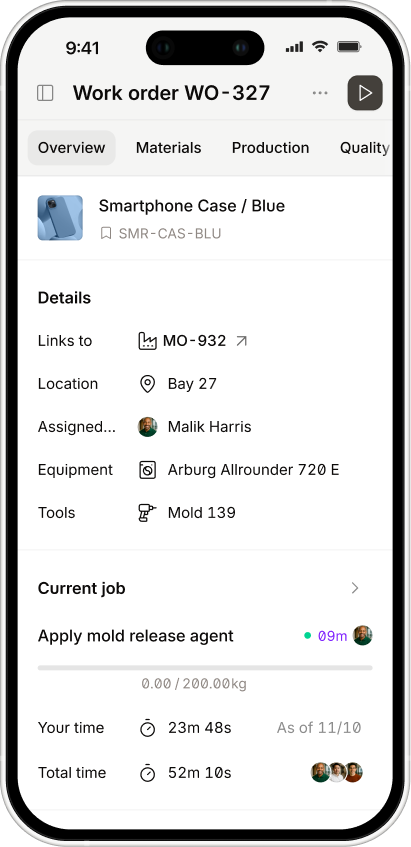
Demand forecasting rounds this out by using real-time inventory data to flag shortages by email before they become a production stoppage, while giving teams live visibility into work orders and job progress across machines and sites — the same real-time tracking this article has already made the case for as a way to reduce excess WIP and keep production moving smoothly.
If you’d like to give Digit a spin, you can book a call, and we can take you through the software and give you a first-hand demonstration of how Digit can be used to help you better track and reduce your WIP inventory.
.jpg)


.jpg)